
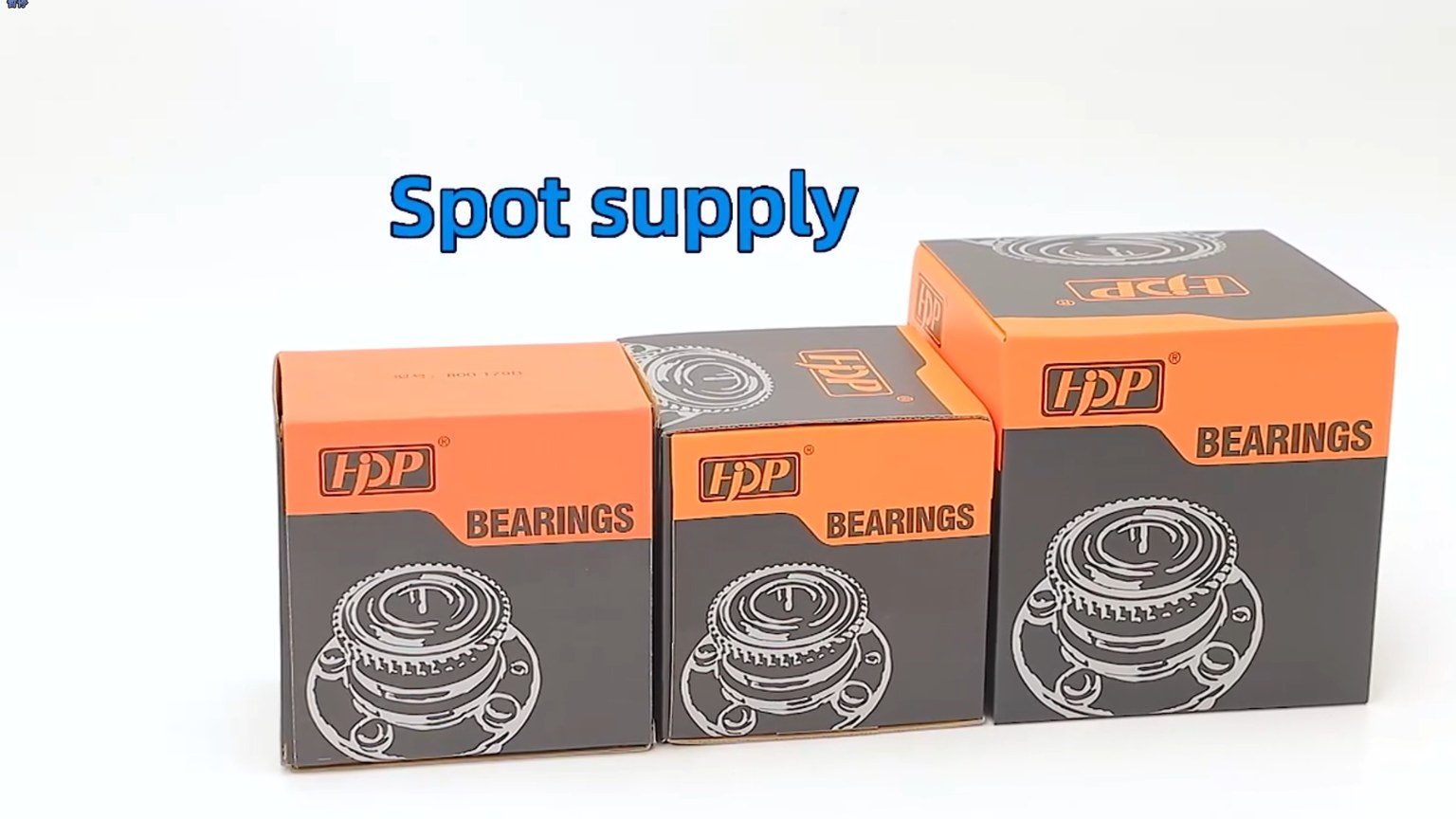
A wheel hub bearing for a Honda Accord is the sealed rolling-element assembly that carries the car's weight at one corner, sets the wheel's axis of rotation, and gives the brake disc and road wheel a true mounting face. On the Accord it is almost always supplied as a complete hub unit rather than a loose bearing. The right part is decided by generation, axle position, bearing type and anti-lock braking system (ABS) interface — not by model year alone. Jinan Huayuan Bearing Co., Ltd. builds these units at huayuanbearing.com for replacement and OE supply, and confirms fitment against drawing and sample.
What Is a Wheel Hub Bearing for Honda Accord and What Does It Carry?
A wheel hub bearing on a Honda Accord does three jobs at once: it carries combined radial and axial wheel loads, it fixes the wheel's rotational axis relative to the suspension, and it provides the precision flange face that the brake disc and wheel clamp against.
Every other decision — row count, contact angle, seal type, flange thickness, stud grade — follows from those three jobs. A part that carries load correctly but locates the disc badly still causes runout, pedal pulsation and uneven pad wear, which is why hub units are specified as an assembly rather than as a bearing with a flange bolted on.
Where the unit sits and which loads reach it
The unit sits between the steering knuckle or rear axle carrier and the wheel. Vertical load arrives through the spring and damper, cornering load arrives laterally through the tyre contact patch, and brake torque arrives through the caliper. On a transverse front-wheel-drive layout — the layout the Accord uses — the front hub is also splined to the outer constant velocity (CV) joint, so it transmits drive torque as well as wheel load. Rear hubs are usually non-driven but still see lateral cornering load and parking-brake torque.
That difference explains why front and rear parts are never interchangeable, even when the bearing bore and flange diameter look close. Load spectra, flange offset and ABS arrangement all change with axle position.
What is inside the assembly
- Two rows of rolling elements running in ground raceways — balls in an angular contact arrangement on passenger-car units.
- Inner and outer rings in through-hardened bearing steel, matched as a set and never mixed between units.
- Hub flange and wheel studs forming the rotating interface to the disc and wheel.
- Seals — an integrated labyrinth or cassette seal on each side, sometimes with a separate slinger.
- Grease charge — sealed for life; a passenger hub unit has no relubrication point.
- ABS encoder — a magnetic encoder ring in the seal, or a toothed ring on older layouts.
If the flange is part of the replaceable assembly, the part is a hub unit; if the bearing presses into a reusable knuckle and the flange is separate, it is a bearing and hub set. The labour, tooling and preload implications are compared in the difference between a wheel bearing and a hub assembly.
Which Generation of Hub Unit Does Your Accord Axle Use?
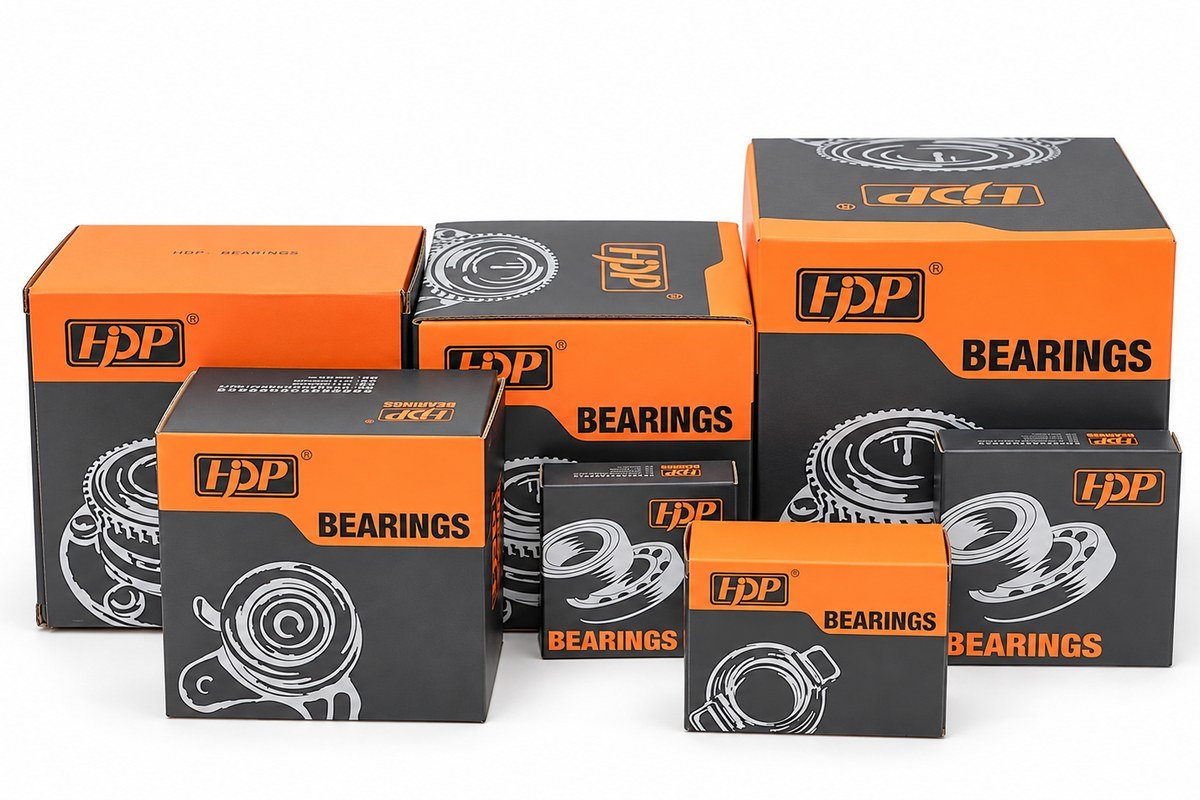
Hub unit generation is decided by how the bearing, flange and mounting interface are integrated — not by the vehicle's model year — and the generation determines whether you press, bolt or replace a complete assembly.
Three generations cover almost every passenger-car application still in service. They differ in what rotates, what is bolted, and how the speed sensor reads the wheel.
| Generation | Construction | How it mounts | ABS interface | Replacement effect |
|---|---|---|---|---|
| Generation 1 | Double-row angular contact bearing with inner-ring flanges, clearance pre-set | Outer ring pressed into the knuckle; inner ring clamped by the axle nut | Separate toothed ring on the hub, read by an inductive sensor | Bearing presses out; knuckle and hub reused; preload set by nut torque |
| Generation 2 | Sealed bearing cartridge with a flange on the outer ring | Flange bolted to the knuckle with three or four bolts | Encoder ring built into the bearing seal | Cartridge replaced as a unit; no field preload adjustment |
| Generation 3 | Bearing, hub flange, mounting flange and studs integrated in one preloaded unit | Bolted to the knuckle or strut as a single assembly | Magnetic encoder in the seal, read through the knuckle | One-piece replacement including studs; encoder type and air gap must match |
Two rules follow. A Generation 3 unit cannot be rebuilt: preload is set at assembly by ground offset between the rows, and pressing the flange out destroys both preload and seal. A Generation 1 or 2 job demands that the knuckle bore and flange face be inspected first, because a worn bore will destroy a correct part within a few thousand kilometres.
huayuanbearing.com catalogues Honda applications by axle position; the format used for front and rear references is shown by a front wheel hub assembly for Honda and a rear wheel hub assembly for Honda, with a further rear hub assembly reference for Honda built to the same drawing discipline. No listing should be matched by name alone — confirm by drawing and sample.
Generation choice also interacts with load rating and sensor type; the wider criteria are set out in this hub and bearing selection guide.
Which Bearing Type, Steel, and Tolerance Class Should the Unit Use?
Double-row angular contact ball bearings are the correct default for Accord-class passenger cars; tapered roller bearings suit applications needing higher radial capacity or a separately adjusted preload, and cylindrical roller bearings belong to heavier driveline and commercial applications rather than passenger hub units.
Ball, tapered roller, or cylindrical roller
Double-row angular contact ball bearings carry radial and axial load in both directions in a compact envelope, with low drag and predictable starting torque — the properties that keep wheel-speed signals clean and fuel consumption acceptable. The contact angle is ground so both rows share load under cornering.
Tapered roller bearings use two rows of tapered rollers on conical raceways. Radial capacity per unit width is higher, but the cups and cones must be preloaded by an axle nut or shim pack, and the assembly is sensitive to that setting. They appear on older rear-drive layouts and light commercial axles.
Cylindrical roller bearings carry very high radial load with low friction but locate the shaft axially only with a companion thrust bearing, so they are used in transmissions, differentials and truck hubs, not in a self-contained passenger hub unit.
Steel grade and heat treatment
Races and rolling elements are normally made from through-hardened 100Cr6 (also designated GCr15 or SUJ2), hardened and tempered to roughly 58–64 HRC and then stabilised so the rings hold size at operating temperature. Flanges are usually forged or machined from medium-carbon steel and must hold stud clamp load without yielding. On a drawing the callouts that matter are steel grade, hardness range, case depth where applicable, and stabilising temperature — not the word hardened on its own.
Internal clearance, preload and nut torque
Clearance groups C2, CN and C3 describe the free internal clearance of a bearing mounted as a separate component. A Generation 3 hub unit does not use field-adjustable clearance: the rows are preloaded at assembly, and the only variable left to the installer is axle nut torque and staking. Over-torque raises preload, running temperature and wear rate; under-torque allows micro-movement between hub and knuckle, producing fretting and eventually false brinelling.
| Parameter | What it controls | Common practice | Confirm on the drawing |
|---|---|---|---|
| Tolerance class | Running accuracy, noise, flange runout | P0–P6 for most replacement parts; P5 where noise is critical | Class stated, plus the flange runout limit |
| Preload or clearance | Load sharing between rows, running temperature | Generation 3 units preloaded at assembly | Preload value or clearance group; rows not interchangeable |
| Steel and heat treatment | Fatigue life, dimensional stability | Through-hardened 100Cr6 (GCr15 / SUJ2) | Grade, hardness range, stabilising temperature |
| Seal design | Contamination exclusion, grease retention | Integrated labyrinth or cassette seal with slinger | Seal type, lip count, slinger presence |
| Grease | Life at temperature, drag torque | Lithium-complex or polyurea, sealed for life | Grease type, fill mass, base oil viscosity |
| ABS encoder | Signal quality to the control unit | Magnetic encoder ring bonded into the seal | Encoder type, pole count, sensor air gap |
How Do Seals, Grease, and the ABS Encoder Decide Whether the Unit Fits?

Hub units are rejected at the vehicle far more often for seal and sensor interface reasons than for bore or flange dimensions, so those two areas deserve the closest check before a part is approved.
Seal architecture and what it excludes
A passenger hub seal must keep out water, road salt, brake dust and pressure-washer jets while retaining grease for the life of the unit. Integrated labyrinth seals use a long non-contacting path plus a contacting lip; cassette seals combine a metal case, an elastomeric lip and a slinger so the lip runs on a protected surface. A slinger pressed onto the rotating flange throws water outward before it reaches the lip. When comparing suppliers, ask how many lips there are, whether the lip runs on a ground or coated surface, and whether the seal survives the pressing operation.
Grease type and fill
Because the unit is greased for life, the grease is chosen for temperature range and drag budget rather than for serviceability. Lithium-complex and polyurea thickeners are both common; base oil viscosity and fill percentage decide whether the unit runs cool at speed or starves a raceway under load. Greases with different thickener chemistry should never be mixed, which is one reason a sealed unit is not topped up. A stated fill mass or base oil viscosity on a drawing is a functional requirement, not a preference.
ABS encoder and sensor air gap
Most current units use an active magnetic encoder ring bonded into the seal, read by a sensor held in the knuckle at a small air gap; older layouts use a passive toothed ring and an inductive sensor. Pole count and ring orientation must match what the control unit expects, and metal debris or a damaged ring corrupts the signal long before the bearing makes noise. If a replacement hub triggers an ABS warning with no mechanical symptom, check encoder type, ring condition, air gap and connector seating before condemning the bearing. The sequence is detailed in OE number and ABS fitment checks.
How Do You Read the Drawing, Sample, and OE Reference Before Ordering?
A structured drawing review catches wrong parts before production, and it is far cheaper than catching them at the vehicle.
Work through the interface in the order the part is actually assembled, because that is the order in which mismatches appear.
- Mounting interface first. Confirm bolt count, bolt circle, thread size and the pilot diameter that centres the unit in the knuckle or strut.
- Overall height and flange offset. These set wheel and disc position; a small offset error changes track width and caliper alignment.
- Flange diameter, thickness and stud pattern. Check stud thread, length, knuckle radius, press depth and the wheel-seat face finish.
- Bearing envelope. Verify bore, outer diameter, width, row spacing and the preload or clearance callout.
- Seal and grease callouts. Seal type, lip count, slinger, grease type and fill mass.
- ABS interface. Encoder type, pole count, ring position and required sensor air gap.
- Marking and packaging. Part number position, traceability marking, inner box and carton specification if the part carries a private label.
- First-article approval. Measure the sample against every critical dimension, fit it to a reference knuckle where possible, and keep the record with the batch.
Where a catalogue listing and a physical sample disagree, the sample wins. OE references narrow the search but are not a guarantee: supersessions, mid-cycle changes and market-specific variants all exist. Treat any part number, including those on this site, as a starting point to be confirmed by drawing and sample.
Jinan Huayuan Bearing Co., Ltd. develops wheel hub bearings, hub units, tensioners and CV joints from customer drawings and samples, and supports custom packaging and private-label programmes for buyers in the Middle East and Southeast Asia. The details a supplier needs in order to quote accurately are listed in this wheel hub bearing RFQ checklist.
What Are the Common Failure Modes and What Do They Tell You?
Most hub bearing failures announce themselves as a speed-related hum or growl that changes when the steering is loaded left or right, and the failure mode usually identifies whether the cause was installation, sealing or load.
Diagnosis starts with the symptom, not with the part. The table below maps what is found on inspection to the mechanism that produced it.
| Symptom or evidence | Likely mechanism | What it points to |
|---|---|---|
| Speed-related hum that changes when steering is loaded | Raceway spalling or brinelling | Bearing at end of life; confirm before replacing suspension parts |
| Rust-coloured grease weeping at the seal | Water ingress past a worn or damaged lip | Seal design or installation damage |
| Polished, fretting marks on the flange face | Micro-movement between hub and knuckle | Insufficient clamp load or contaminated mating faces |
| ABS lamp on after replacement, no mechanical noise | Wrong encoder type, damaged ring or wrong air gap | Part mismatch or fitting method |
| Play at the wheel despite correct torque | Stretched or reused fastener | Single-use hardware not replaced |
| Rough rotation straight out of the carton | Impact damage or storage brinelling | Handling and packaging, not bearing design |
A bearing that is noisy but tight and one that is quiet but loose are different problems with different causes. Confirming which you have before ordering parts avoids replacing a hub for a tyre or suspension noise; the listening and load-transfer checks are described in how to tell a wheel hub bearing is failing.
How Do You Install, Replace, and Inspect a Hub Bearing?
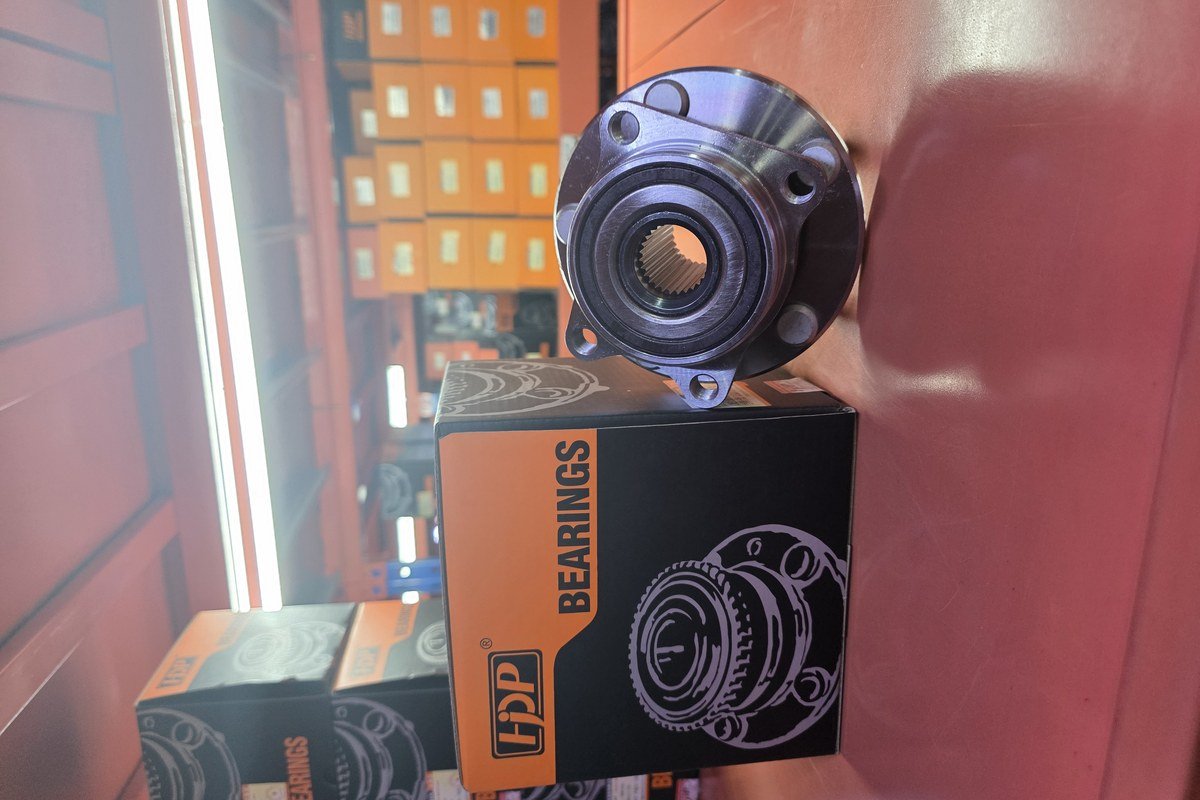
Correct installation preserves the preload and the seal built into the unit at the factory; most premature failures on new parts trace back to the fitting sequence rather than to the bearing.
Installation sequence
- Clean the knuckle bore and mating flange face to bare metal and keep them dry; corrosion or grease under a friction joint costs clamp load.
- Compare the new unit with the removed part before fitting — flange offset, stud pattern, encoder type and seal position.
- Press or draw the unit in with a driver that bears on the outer ring or mounting flange, never on the inner ring, the seal or the balls.
- Torque mounting bolts and the axle nut to the specified figure with a calibrated wrench, in the specified sequence, using new single-use fasteners where required, and stake the nut if the design calls for it.
- Refit the disc and check lateral runout before fitting the wheel; debris trapped on the hub face shows up here.
- Seat the ABS sensor, confirm the connector, and check the air gap where the design allows adjustment.
- Road test: confirm the noise is gone, the ABS lamp stays off, and there is no play at the 12–6 or 3–9 o'clock positions with the wheel raised.
Incoming inspection at the warehouse
- Cartons intact, no crushing or water staining, units still seated in their moulded trays.
- Part marking legible and matching the invoice, packing list and approved drawing.
- Hand rotation smooth both ways, with no detectable axial play and no click or catch.
- Seal lips undistorted, no grease weeping, slinger present and undamaged.
- Flange face flat and unmarked, studs straight, fully seated and free of thread damage.
- Encoder ring clean and intact, correct type, no metal swarf on the magnetic surface.
- Sampled dimensional check of the critical characteristics on the approved drawing, recorded per batch.
Keeping first-article and batch records turns a fitment complaint into a measurable question, which is also the fairest basis for comparing two suppliers.
Frequently Asked Questions
Is a Honda Accord wheel hub bearing the same front and rear?
No. Front and rear units differ in flange geometry, load rating, ABS encoder arrangement, and whether the hub is splined for a driveshaft. They are not interchangeable even when the bearing bore looks similar. Match by axle position first, then confirm the OE reference against the physical sample rather than against a catalogue title.
Can you replace just the bearing instead of the whole hub unit?
Only on Generation 1 or 2 designs where the bearing is a separate pressable component and the hub and knuckle are serviceable. On a Generation 3 unit the bearing, flange and studs form one preloaded assembly, and splitting it destroys the preload and the seal. Identify the construction before ordering either option.
What causes a new hub bearing to fail within a few thousand miles?
Usually installation rather than the part: pressing on the inner ring, reusing a stretched axle nut, a dirty knuckle bore, or a seal damaged during fitting. A wrong encoder type or a bent encoder ring produces an ABS warning with no bearing noise at all. Impact damage in transit brinells the races before the unit is ever mounted.
How do I confirm the correct part before placing an order?
Supply the OE reference, the axle position, and a drawing or a physical sample. The supplier should verify flange geometry, stud pattern, seal type and encoder type against the sample and confirm the result in writing. huayuanbearing.com works from drawings and samples for exactly this reason, including custom packaging and private-label supply.
Purchasing guidance, product information and company updates from Huayuan Bearing.