
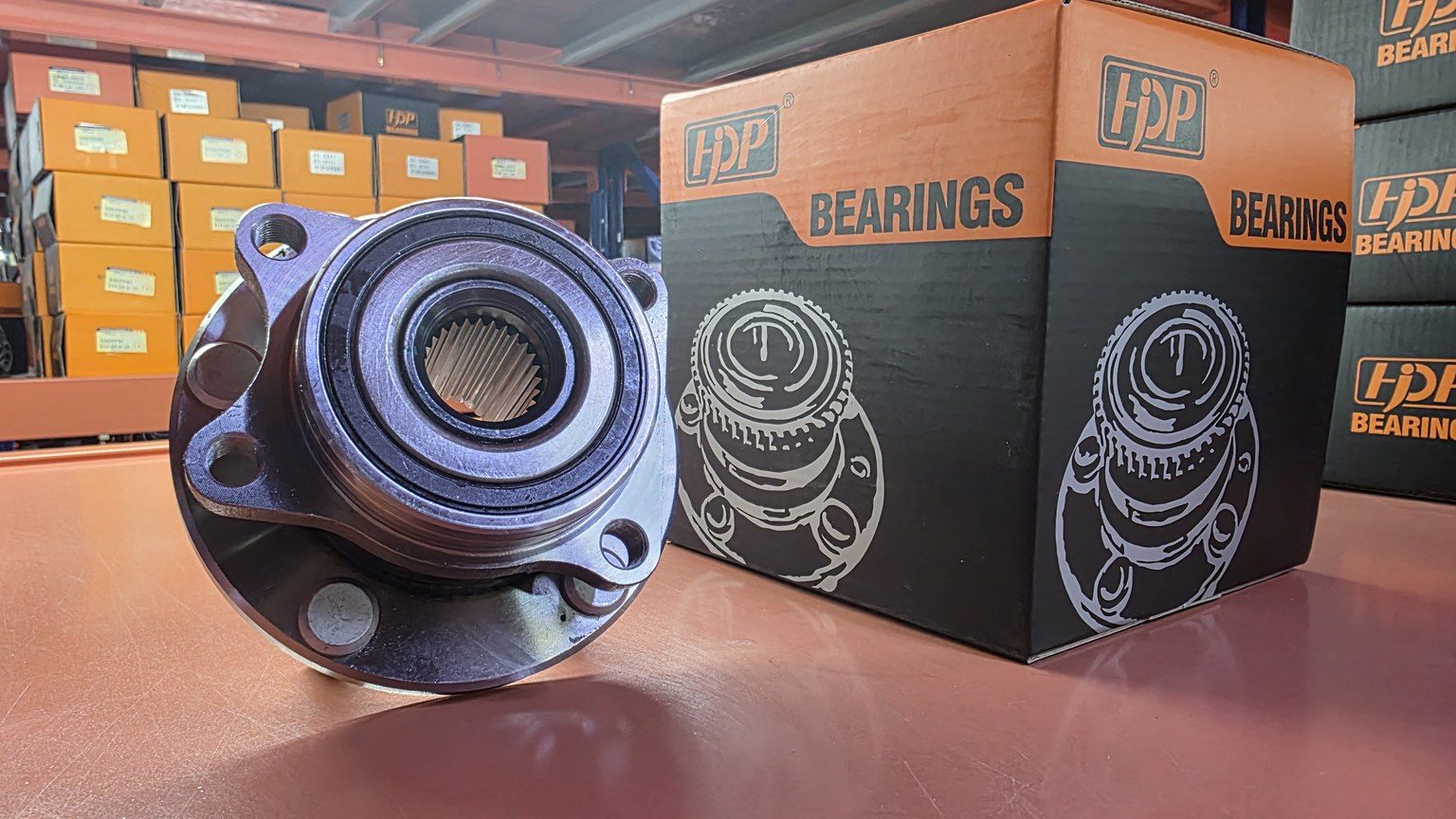
The wheel hub bearing for TOYOTA YARIS is a sealed, pre-greased unit that supports the wheel hub on the knuckle or rear axle and lets it rotate with minimal friction while holding the wheel in a fixed position. On most YARIS applications it is supplied as an integrated hub unit containing the flange, a double-row bearing and, where the car has ABS, a magnetic encoder ring. Correct selection depends on unit generation, flange geometry, encoder type and the internal design shown on the drawing — confirmed against the OE reference and a physical sample, not the model name alone.
What Is a Wheel Hub Bearing for TOYOTA YARIS and What Does It Carry?
A wheel hub bearing for TOYOTA YARIS is the rotating support between the wheel hub and the suspension or axle, and on this vehicle class it is a sealed assembly rather than a loose pair of bearing rings. Its function is to carry the corner weight of the car, absorb cornering and braking loads, and keep the wheel in a fixed position relative to the suspension so that wheel alignment, brake disc alignment and ABS signal timing all stay correct.
Where the unit sits and which loads it takes
The front unit sits in the steering knuckle and carries the highest combined load on the car. It sees the vertical weight of the front axle, a bending moment transmitted through the flange during cornering, the reaction to braking torque through the disc, and — because the YARIS is a front-wheel-drive platform — drive torque through the CV joint spline. The rear unit is normally non-driven and carries no drive torque, but it still absorbs cornering moment and, on disc-brake versions, a significant heat input from the brake. Load capacity is therefore set by the internal design of the bearing — ball or roller, contact angle, number of rows and preload — not by the size of the mounting bolts.
Which generation of hub unit a YARIS-size platform uses
Most YARIS-size passenger cars are built with a second- or third-generation hub unit at the front and either a pressed first-generation bearing or a bolt-on unit at the rear, depending on model year, market and brake type. The generation defines how the part is installed, how the ABS signal is generated and how much of the assembly has to be replaced when a bearing wears out. The three architectures are not interchangeable even when some flange dimensions coincide.
| Unit generation | Construction | Loads handled | ABS interface | Service implication |
|---|---|---|---|---|
| First generation | Double-row bearing with separate inner and outer rings, pressed into the knuckle; hub flange is a separate part | Radial load plus axial load from cornering and braking | Encoder ring on the bearing, or a separate sensor ring on the shaft | Needs press tooling and correct seating depth; seal is usually a separate component |
| Second generation | Bearing unit with an integrated outer flange bolted to the knuckle; inner rings mounted on the hub shaft | Same load path as first generation, with a stiffer mounting | Magnetic encoder integrated into the seal | Bolted rather than pressed, but the knuckle face must be clean and flat |
| Third generation | Complete hub assembly: flange, bearing pair, encoder and mounting holes in one matched unit | Radial load plus wheel moment, designed and preloaded as one assembly | Encoder and sensor interface built into the unit | Replaced as a whole; no bearing extraction or press work |
The practical consequence is that one vehicle name can carry several different parts across model years and markets. A pressed first-generation bearing and a bolt-on third-generation unit are different products, and a complete hub assembly is not the same item as the bearing inside it — the difference between a wheel bearing and a hub assembly is worth confirming before any order is placed.
How Is a Hub Bearing Unit Built — Races, Rollers, Seals and Grease?
A hub bearing unit is a matched set of two rows of rolling elements running on hardened raceways, preloaded during assembly, sealed, lubricated for its service interval and, on ABS-equipped cars, fitted with a magnetic encoder. Each of those five elements — raceway, rolling element, preload, seal and encoder — decides a different part of the unit's behaviour in service.
Balls, tapered rollers or cylindrical rollers
Double-row angular contact ball bearings are the usual choice for YARIS-class hub units because they combine radial and axial capacity with low friction and low noise. Tapered roller bearings carry higher combined loads but handle axial load in one direction only, so they must be mounted as opposed pairs with a defined setting; they appear where durability under heavy axial load matters more than friction. Cylindrical roller bearings carry very high radial load with almost no axial capacity and belong to heavier commercial applications rather than passenger-car hubs.
Material and heat treatment
Raceways and rolling elements are made from through-hardening bearing steel — 100Cr6, GCr15 or AISI 52100 equivalents — hardened and tempered to a fine martensitic structure. Hub flanges and outer bodies are typically forged or machined from medium-carbon steel, with the bearing rings in bearing steel; some designs use case-carburised parts where a tough core is needed under a hard surface. Hardness, case depth and retained austenite are controlled because they set fatigue life and dimensional stability under heat: an under-hardened raceway pits early, while excessive retained austenite allows the ring to grow in service and lose preload.
Seals, grease and the ABS encoder
Sealing decides service life more than any other feature in road use. A single-lip seal is adequate in dry climates; multi-lip and cassette seals with a grease-retention lip plus a dirt-exclusion lip are preferred for wet, dusty or salted roads. Grease fill volume and base-oil viscosity are selected for the operating temperature range, and both under-filling and over-filling shorten life — the first through starvation, the second through churning and heat. The encoder is a magnetised ring, bonded into the seal or mounted on the bearing, read by the ABS sensor across a defined air gap; a unit with the wrong encoder type produces an ABS fault even when the bearing itself is mechanically correct.
Which Parameters on the Drawing Actually Decide Fitment?
The drawing is the only reliable description of a hub unit, because two units that look alike on a shelf can differ in ways that only appear at installation. The parameters below are the ones that decide whether two parts are genuinely the same item.
| Parameter on the drawing | What it defines | Why it decides fitment |
|---|---|---|
| Unit generation and part number | Overall architecture of the assembly | Mixing generations changes the mounting method and sensor position |
| Flange bolt circle and hole count | How wheel and brake disc attach | A wrong bolt circle cannot be corrected during installation |
| Stud thread and knurl diameter | Stud retention in the flange | Studs must match the vehicle nuts and the specified torque |
| Flange diameter and offset | Seating position of disc and wheel | Offset errors disturb brake and wheel alignment |
| Inner bore and shaft fit | Interface with CV joint or spindle | Wrong fit causes spin on the shaft or loss of preload |
| Encoder type and air gap | ABS signal generation | Wrong encoder type triggers an ABS fault code |
| Seal design and lip count | Contamination exclusion and grease retention | Determines life in wet, dusty or salted conditions |
| Grease type, fill and temperature range | The lubrication envelope | Wrong grease or fill volume shortens life and raises running temperature |
| Precision grade, clearance or preload | Running accuracy and internal fit | Affects noise, heat generation and fatigue life |
Precision grade and clearance are usually quoted with standard designations — ISO P0 to P6 or ABEC equivalents for running accuracy, and CN or C3 clearance groups where a clearance value is specified rather than a preload. On a sealed hub unit the preload is normally set by design during assembly, so the drawing value describes the finished assembly rather than something the installer adjusts.
Which Wheel Hub Bearing for TOYOTA YARIS Do You Need, and How Do You Confirm It?
The correct wheel hub bearing for TOYOTA YARIS is the unit whose OE reference, flange geometry, encoder type and internal bearing design match the part currently on the vehicle. A catalogue entry under the model name is a starting point, not a confirmation, because the same nameplate covers several build configurations across markets and years.
Why the model name alone is not enough
YARIS derivatives differ by market in brake type, ABS generation, engine and even plant, and those differences change the hub unit. A rear drum-brake car may use a pressed bearing where a disc-brake car uses a bolt-on unit; an early non-ABS car has no encoder at all. Catalogues also lag production changes and often list a superseded number alongside the current one, which is why checking the OE number against the ABS encoder and flange data is more reliable than matching on the vehicle name.
How to identify the right unit in six steps
- Read the OE reference from the old unit: it is normally cast or laser-marked on the flange, the outer ring or the housing, and often appears on the original box as well.
- Record the fitment dimensions with a caliper: flange outer diameter, bolt circle, hole or stud count, stud thread, overall height and inner bore.
- Identify the ABS arrangement: encoder bonded in the seal or mounted on the ring, sensor connector shape and pin count, and the condition of the encoder surface.
- Confirm the vehicle build details — model year range, market, brake type front and rear, and whether ABS is fitted — rather than relying on the badge.
- Compare the recorded data with the supplier drawing line by line, and ask for the specific dimension that differs to be re-measured rather than assumed.
- Approve a pre-production sample against the drawing, then lock the drawing revision so later production batches are compared with the same document.
Where catalogues and samples overlap
Part numbers, not model names, are how the aftermarket actually identifies hub units, and a single Toyota platform can carry several numbers across model years and markets. Published references such as this front hub assembly reference for Toyota applications and its companion front hub assembly part number listing show how the numbering works in practice. Each still has to be confirmed against drawing and sample before it is offered for a specific YARIS variant, and the same applies to rear rear hub assembly references for Toyota vehicles. For a structured comparison of bearing-only and complete-assembly options, the hub assembly selection guide sets out the trade-offs in load capacity, installation time and stock coverage.
What Makes a YARIS Hub Bearing Fail, and How Do You Judge It?
Most hub bearing failures on a YARIS-class car start with a seal breach and loss of grease, or with damage during installation; true fatigue spalling of a correctly installed, correctly sealed unit is comparatively rare within normal service life. That order of probability matters, because it tells a buyer where to look first when a part comes back as a warranty claim.
Noise and vibration signatures
A worn hub bearing usually produces a hum or growl that rises with road speed and changes when the steering is loaded in a curve, because the load shifts across the damaged raceway. The noise is often mistaken for tyre roar, so the diagnostic check is to compare both sides and to note whether the sound changes on a left or right sweep. Roughness felt by hand while rotating the removed unit, or visible pitting on a raceway, confirms the diagnosis.
Water, dust and brake heat
Seal lips wear, harden and lose contact pressure with age, and once water or abrasive dust reaches the grease the raceway pits and the grease discolours. Frequent heavy braking adds heat that ages grease faster and can soften a seal lip, and a wheel that has been submerged or driven through deep water is a common starting point for corrosion on the raceway. In these cases the seal and the grease condition tell the story more clearly than the noise does.
Installation damage versus genuine wear
Pressing on the inner ring instead of the outer ring, hammering a unit into place, reusing a stretched axle nut or fitting onto a dirty knuckle face all damage a new bearing before it turns a wheel. Damage of this type typically appears within the first few thousand kilometres and leaves marks that are visible on inspection — brinelling across the raceway, a distorted seal lip or a scored bore. Distinguishing it from wear matters commercially, because the two have different causes and different corrective actions.
| Symptom | Most common cause | What to check |
|---|---|---|
| Hum or growl rising with road speed | Raceway spalling after grease loss or water ingress | Seal condition, grease colour, raceway pitting |
| Noise changes when cornering | Load shift across a worn raceway | Compare both sides; feel for roughness when rotating |
| Play at the wheel, rocking top to bottom | Loose axle nut, worn bearing or damaged hub | Nut torque history, bearing clearance, hub condition |
| ABS warning with no mechanical noise | Encoder or sensor air gap problem | Encoder ring damage, metallic debris on the sensor face |
| Grease weeping at the seal | Seal lip wear, over-filling or blocked vent | Lip condition, fill volume, housing cleanliness |
| Uneven or feathered tyre wear | Hub play or excessive runout | Runout measured with a dial gauge on the flange |
The full symptom set, including the checks a workshop can run without dismantling the corner, is set out in this guide to the signs of a failing wheel hub bearing.
How Should a Replacement Hub Unit Be Installed and Inspected?
A replacement hub unit performs only as well as its installation and its incoming inspection allow, and both are controllable at the buyer's end. Installation errors cause early failures that look like quality problems, while weak incoming inspection lets dimensional drift reach the shelf unnoticed.
Installation points that decide service life
Clean the knuckle or axle face until it is free of rust, old thread-locker and burrs, because any debris tilts the unit and loads one side of the raceway. Press or draw the unit in by its outer ring or flange, never by the inner ring or the encoder, and never strike it with a hammer. Use the torque figure and sequence specified for the vehicle, fit a new axle nut where the design calls for a staked or stretch nut, and keep magnetic encoders away from metal particles and strong magnetic fields during handling. After fitting, rotate the wheel by hand and check for roughness and play before the car is driven.
Incoming inspection for importers and distributors
A short, repeatable inspection at goods-in catches most problems before they reach a customer. It does not need a metrology laboratory, but it does need a record for each batch.
- Compare carton labels, part numbers and drawing revision against the purchase order and the approved sample.
- Measure the fitment dimensions on a sample from each batch: flange diameter, bolt circle, bore and overall height.
- Check seal seating and lip condition, and confirm the encoder type matches the approved specification.
- Rotate several units by hand and listen for roughness, then check for axial and radial play.
- Inspect for rust prevention coverage, packaging protection and stud condition.
- Retain one unit per batch as a reference sample, labelled with the batch and date.
The wheel hub bearing RFQ checklist lists the information that should be exchanged before production so that these checks have a reference to compare against.
Where the manufacturer's capability matters
About the manufacturer. Jinan Huayuan Bearing Co., Ltd. (huayuanbearing.com) is a bearing manufacturer and exporter based in Jinan, Shandong, producing wheel hub bearings, hub units, tensioners and CV joint components for aftermarket replacement and OE-matching supply, serving overseas buyers mainly in the Middle East and Southeast Asia. The company develops parts to drawing and sample, and supports custom packaging and private-label programmes; fitment for any specific YARIS variant is confirmed against drawing and sample before production.
Frequently Asked Questions About the YARIS Wheel Hub Bearing
Does a YARIS use a wheel bearing or a complete hub assembly?
Both arrangements exist depending on model year, market and axle. Many front applications use a complete hub assembly in which the bearing, flange and encoder are one matched unit, while some rear applications use a bearing pressed into the hub or knuckle. The part on the vehicle, identified by its OE reference and dimensions, decides which type is required — confirmed against drawing and sample.
Can the bearing alone be replaced instead of the whole unit?
Only where the design allows it. A first-generation pressed bearing can be extracted and replaced with press tooling, but second- and third-generation units are matched assemblies with set preload and integrated encoders, and separating them destroys that setting. Attempting a bearing swap on a sealed unit usually produces noise, premature failure or an ABS fault.
What information should I send to get an accurate quotation?
Send the OE reference, the vehicle's model year range, market and brake type, the ABS arrangement, and measured dimensions including flange diameter, bolt circle, stud thread, bore and overall height. A photograph of the old unit and, where possible, a sample allow the drawing to be verified properly rather than matched from a catalogue description.
Are all YARIS hub bearings the same across model years?
No. Flange geometry, bolt pattern, encoder type and unit generation change between model years and markets, and a part that fits one build may not fit another with the same badge. Cross-referencing by OE number and confirming the drawing is the reliable route; treating the model name as a single specification is the most common cause of wrong-part returns.
Purchasing guidance, product information and company updates from Huayuan Bearing.