
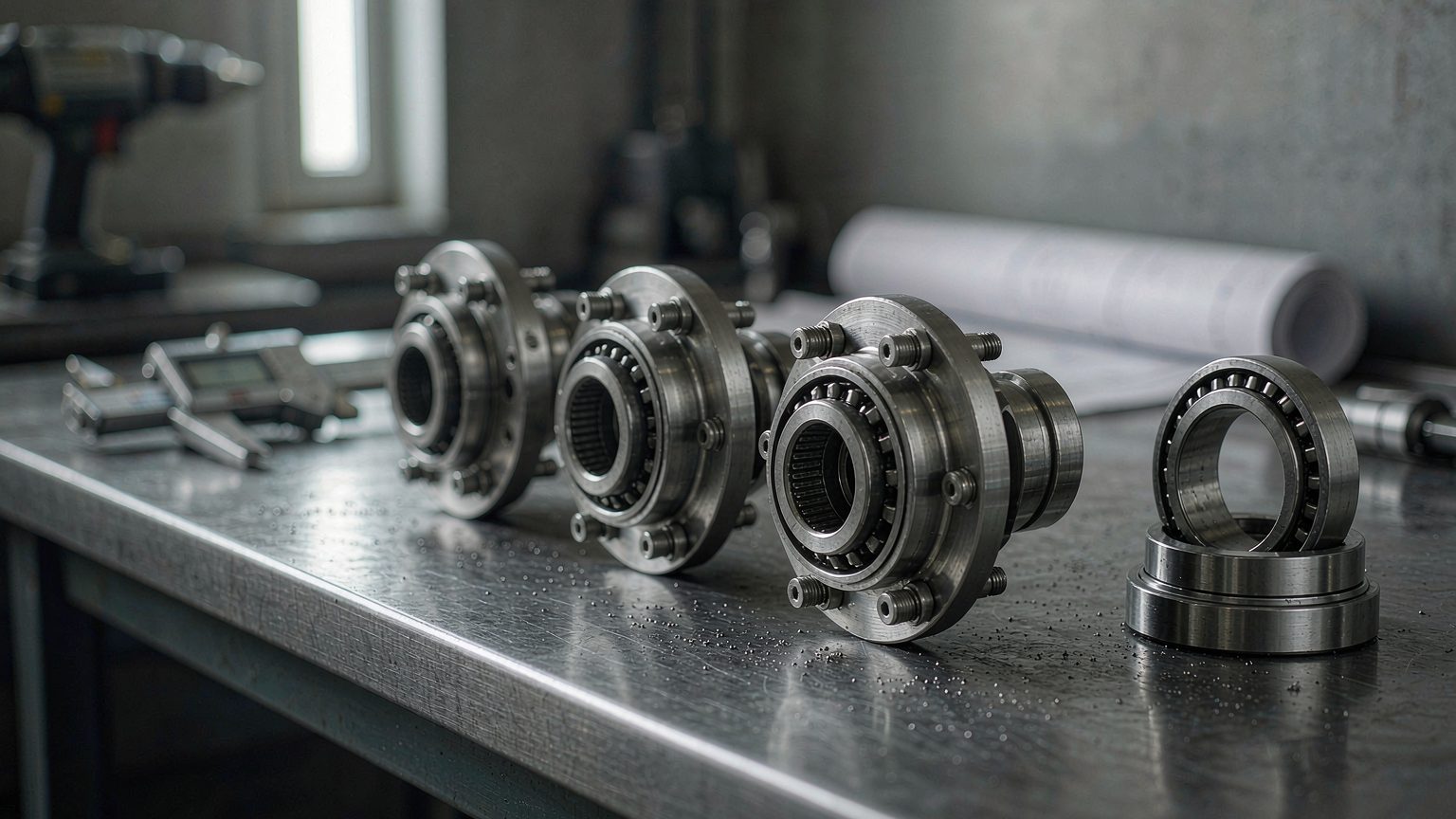
A stepped bearing is a rolling bearing whose inner or outer ring carries a machined step — a change in ring diameter along the axis — that forms an integral shoulder for axial location, spacing or seal seating. Russian-speaking buyers search for it as ступенчатые подшипники, literally “stepped bearings”, but the phrase describes geometry rather than a standard series, so the drawing defines the part. Jinan Huayuan Bearing Co., Ltd. (huayuanbearing.com) manufactures wheel hub bearings, hub units, tensioners and CV joints to drawing and sample for aftermarket and OE customers, mainly in the Middle East and Southeast Asia.
What Are Stepped Bearings, and Why Does One Term Cover Several Parts?
A step is an integral shoulder machined into a bearing ring, so the bearing positions itself axially instead of relying on a separate spacer, sleeve or snap ring.
The ring is turned with two diameters, heat treated, then face-ground and raceway-ground, and the annular face where the two diameters meet becomes the step face. That face abuts a shaft shoulder, a housing shoulder, a spacer or a seal lip and passes axial load straight into the ring section. In practice this shortens the housing, removes a part from the assembly stack and fixes axial position independently of how far a fitter presses the bearing in. The cost is geometric: the step face must be ground square to the axis, because a face that runs out tilts the ring and loads one row of rollers harder than the other.
Inner-ring step or outer-ring step?
An inner-ring step seats on a shaft shoulder, so the axial reaction travels through the inner ring and the shaft fit must be a true interference fit with a square shoulder.
An outer-ring step seats in a housing bore or carries a seal. Where a housing has no machined shoulder, a stepped or flanged outer ring is often the only way to locate the bearing axially without a snap ring. Assembly direction follows the same logic: the stepped ring is normally the press-fit ring, and pressing force must be applied to that ring only, never transmitted through the rolling elements.
Why Russian buyers say “ступенчатые подшипники”
Ступенчатые подшипники is Russian for “stepped bearings”, and in trade usage the phrase covers at least three different products, which is the main reason it produces mismatched quotations.
- Hub bearings whose outer ring is stepped or flanged to seat at a fixed depth in a steering knuckle or axle housing.
- Shaft bearings with an extended, stepped inner ring that doubles as a spacer between two bearings on the same shaft.
- Tapered roller bearings whose cup seats against a machined step in the housing rather than against a conventional shoulder.
Because the word describes shape rather than a boundary dimension series, two suppliers can both quote a “ступенчатый подшипник” and deliver parts that do not interchange. A usable enquiry carries bore, outside diameter, width, step diameter, step length and a photo or sample; anything less is guesswork on both sides.
Stepped ring, flanged ring or separate spacer: which to specify
The right choice depends on what the housing and shaft already offer, because all three designs do the same axial-locating job with a different part count and a different failure point.
| Design | How axial position is set | Where it earns its cost | What to watch |
|---|---|---|---|
| Stepped ring | Integral shoulder bears on a machined face on shaft or housing | Removes a spacer, shortens the stack, fixes position regardless of press depth | Step face squareness and runout; extra grinding cost per part |
| Flanged outer ring | Flange traps the ring against a housing face, often with bolts | Housings without a shoulder; hub units that bolt to the knuckle | Flange flatness, bolt torque, corrosion between flange and housing |
| Bearing plus spacer | Separate sleeve or distance piece between ring and shoulder | Cheap catalogue parts, easy to stock and replace individually | Spacer length adds to the tolerance stack; a missing spacer changes preload |
| Snap-ring located | Ring in a groove holds the outer ring in the bore | Blind bores and through-bores without shoulders | Groove wear, ring seating, axial play inside the groove |
If the housing already has a machined shoulder, a plain ring with a snap ring is usually the lowest-cost correct answer. If it does not, a stepped or flanged ring avoids machining the housing at all. If the shaft stack needs a precise distance between two bearings, an extended stepped inner ring removes one part and one tolerance from the stack — but it also removes the ability to correct that stack during assembly.
How Is a Stepped Bearing Built, and What Actually Decides Its Quality?
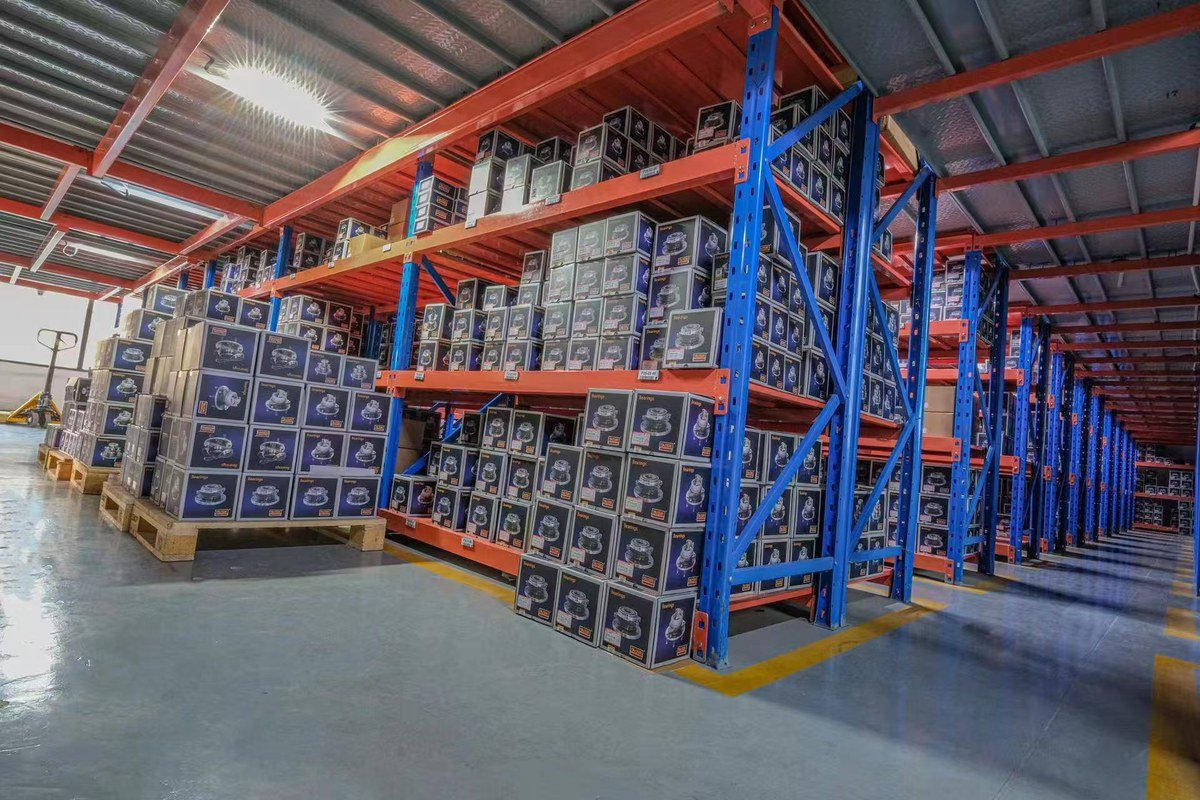
The grinding sequence decides concentricity
Concentricity between the step diameter and the raceway is created at grinding, not at final inspection, so the process sequence matters more than the catalogue description.
Blanks are turned from tube or forging, heat treated, face-ground, then raceway-ground and superfinished; wherever the geometry allows, the step diameter is ground in the same setup as the raceway so both share one axis. Assembly follows: roller sorting, cage fitting, grease dosing, seal pressing. A supplier that grinds the step in a second operation can still deliver a good part, but the runout budget then has to be inspected rather than assumed. Two visible indicators help a buyer: the step face should show grinding marks across the full face rather than turning marks, and the raceway should be uniformly grey with no chatter bands.
Steel grade and heat treatment
Automotive rings and rollers are usually made from through-hardening bearing steel such as 100Cr6, GCr15 or AISI 52100, hardened in the high-fifties to low-sixties HRC and tempered for dimensional stability.
Where shock loads or thin sections are involved, carburizing grades are used instead, giving a hard case over a tough core. That trade-off is invisible in a photograph but shows up in service as resistance to cracking under impact and misalignment. Buyers cannot verify case depth with a caliper, so the practical control is a supplier who states steel grade and heat-treatment route on the drawing and holds the same route from batch to batch. Statements such as “high quality bearing steel” describe nothing that can be checked.
Tolerance class, clearance and preload
Three separate specifications decide whether a stepped bearing behaves correctly: dimensional and running tolerance class, internal clearance or preload, and the tolerances on the step itself.
Dimensional and running accuracy is normally quoted in ISO 492 classes, from P0 through P6, P5 and P4; radial internal clearance is quoted in ISO 5753 groups such as CN, C3 and C4. Hub units are preloaded during assembly and cannot be adjusted in service, whereas separately supplied tapered wheel bearings are adjusted at installation by nut or shim to a specified end play. The step tolerances — diameter, length, face runout and corner radius — are usually the parameters the customer writes on the drawing rather than the ones a catalogue lists.
| Parameter | How it is usually written | What it controls | When it must be tightened |
|---|---|---|---|
| Dimensional tolerance class | ISO 492 P0, P6, P5 | Bore, outside diameter and width limits; running accuracy | High-speed shafts, low-noise duty, precision spindles |
| Radial internal clearance | CN, C3, C4 | Operating clearance after interference fit and thermal growth | Hot housings, heavy interference fits, low-speed high-load axles |
| Preload | Axial preload value or setting torque | Stiffness, noise, roller skidding | Hub units, pinion heads, matched tapered pairs |
| Step diameter and length | Nominal plus tolerance on the drawing | Seating depth and axial position of the ring | Whenever the step carries axial load or a seal lip |
| Step face runout | Runout value relative to the raceway axis | Ring squareness and load sharing between rows | Double-row and paired bearings, any stepped ring |
| Seal counterface finish | Ground, with a roughness value | Lip wear, grease retention, contamination ingress | Sealed units, dusty or wet duty |
Seals, grease and the surface the lip runs on
A seal is only as good as the surface it runs on, and on a stepped bearing that surface is usually part of the step.
Open bearings rely on the housing lubricant; shielded versions (ZZ) slow contamination down without rubbing; contact seals (2RS) retain grease and exclude water at the cost of some drag. Elastomer choice follows temperature: NBR for normal duty, HNBR and FKM where heat is higher. Sealed hub units carry a lifetime grease fill, typically lithium-complex or polyurea, and a magnetic encoder seal where the ABS sensor reads at the bearing. If the step surface under the lip is turned rather than ground, the lip wears a groove and the unit leaks long before the raceway fails.
Which Stepped Bearing Type Fits Which Position?
Tapered, cylindrical or ball: the load path decides
The rolling element is chosen by load direction first and by speed second; the step only changes how the ring is located.
| Type | Load it carries | Typical stepped use | Practical note |
|---|---|---|---|
| Tapered roller | Radial plus axial in one direction; needs an opposed bearing or a preloaded pair | Wheel hubs on light commercial vehicles and trailers, pinion shafts, differentials | Cup and cone must be matched and set to the specified end play or preload |
| Cylindrical roller | High radial load, little or no axial; flanged designs take axial in one direction | Gearbox shafts where a stepped inner ring also spaces a gear | Housing-to-shaft bore alignment matters more than the clearance group |
| Deep groove ball | Radial plus moderate axial in both directions | Tensioner and idler pulleys, small hub units, accessory drives | Low drag and low noise; sensitive to contamination once the seal is damaged |
| Double-row angular contact | Radial plus axial in both directions, preloaded | Hub units of generations 1 to 3 | Preload set at build; not adjustable and not repackable in most designs |
A stepped ring appears where axial position must be fixed without adding parts: a gearbox shaft carrying a gear between two bearings, a pinion head with a defined position, or a hub that must sit at a fixed depth in the knuckle so the ABS sensor air gap stays correct.
Where the step sits in hub unit generations 1, 2 and 3
The generation number describes how the bearing is integrated with the flange, and it tells you what the step is expected to do.
A generation 1 hub unit is a self-contained double-row bearing pressed into the knuckle or hub and retained by a snap ring or shoulder; the outer ring may be stepped or flanged to seat at a fixed depth. A generation 2 unit carries a flange on the outer ring that bolts to the knuckle or brake backing plate, so the housing bore disappears and the flange face sets axial position. A generation 3 unit puts the wheel-mounting flange on the inner ring and the suspension-mounting flange on the outer ring, with the ABS encoder integrated in the seal; the unit is preloaded and sealed for life and is replaced as an assembly rather than adjusted.
Because the three generations look similar on a shelf, identification has to come from the flange pattern, the sensor arrangement and the drawing — never from the phrase “stepped bearing” alone. Huayuan Bearing produces wheel hub bearings and hub units to drawing and sample, and every part is confirmed against those dimensions before production.
Tensioner pulleys and CV joints
A tensioner pulley is a sealed deep groove ball bearing inside a pulley shell, often with an offset or stepped outer ring, and its failure mode is usually seal failure rather than raceway fatigue.
The loads are modest but speed and temperature are not, and the belt runs on the pulley face, so radial runout of that face matters as much as internal clearance. A CV joint is a different assembly: balls ride in hardened tracks, a cage holds them, and drive is transmitted at constant velocity through a variable angle. It is supplied and replaced as a complete unit, and the relevant “step” is the housing shoulder or snap ring that locates the joint in the transmission or hub.
How Do You Read a Drawing or a Sample Before You Order?
The dimensions a stepped bearing drawing must carry
A stepped bearing cannot be quoted from a model name, because two vehicles of the same year can use different hub designs; the drawing or the sample is the specification.
- Bore d, outside diameter D and width B or T, each with tolerance.
- Step diameter and step length, plus the face the step bears against.
- Shoulder height, corner radii and chamfers, which decide whether the ring clears a fillet.
- Seal type, seal seat diameter and the finish of the counterface.
- Tolerance class, internal clearance or preload, and the marking to be applied.
- Grease type and fill for sealed parts, and encoder position where relevant.
A seven-step check before the first batch
Confirming a part takes measurements and photographs, and it is far cheaper than a rejected container.
- Identify the mounting position and note which ring is press-fit and which is free.
- Measure bore, outside diameter and width at three points with a calibrated micrometer, and record the mean and the spread.
- Measure step diameter and step length, then check step face squareness with a dial indicator on a surface plate.
- Record shoulder radius and chamfer, because these decide whether the ring seats flat.
- Photograph the seal, cage, marking and any wear pattern on the sample, with a scale in the frame.
- Write clearance or preload, seal type and grease into the drawing, not only into an email.
- Keep the approved sample and signed drawing as the reference for every later batch, and compare first articles against both.
Why an OE number is a starting point, not proof
OE numbers are useful for narrowing a search and unreliable as a final specification, because numbers supersede, designs change within a production run, and catalogue mappings are not always correct.
The dependable route is two-way confirmation: the drawing states geometry and tolerances, and the sample confirms what a drawing cannot describe, such as seal profile, cage material and the real step depth measured in a used housing. Send both to the manufacturer — Huayuan Bearing confirms geometry, tolerance class and packing against drawing and sample before a batch is scheduled, which is the point where mismatches are still cheap to correct.
Which Load and Operating Conditions Change the Specification?
Load direction, magnitude and shock
Load direction selects the bearing type; load magnitude selects the size and the steel route.
A hub bearing carries vehicle weight as radial load and cornering force as axial load, and both reverse as the wheel rotates, which is why hub units are double-row and preloaded rather than single-row. Shock loading — kerbs, potholes, loaded trailers — strengthens the case for carburized rings and a larger roller complement rather than a higher tolerance class. Misalignment, not load, is the more common cause of early failure in stepped rings, because the step fixes axial position rigidly and has no way to absorb a housing that is not square.
Speed, temperature and contamination
Speed and temperature set the grease, the seal material and the clearance group; contamination decides how long all three survive.
A wheel hub runs at moderate speed but at brake heat, so high-temperature grease and heat-resistant seal elastomer are specified where duty is heavy. A tensioner pulley runs fast with light load and needs low-drag grease and a seal that does not rub hard. Dust, water crossings and pressure washing attack the seal lip first; once water enters, the grease emulsifies and the raceway fails within a short distance. Clearance follows the same logic: a hot housing or heavy interference fit consumes clearance, so a C3 group may be needed where a CN group would run preloaded and overheat.
How Do Stepped Bearings Fail, and What Do the Symptoms Tell You?
The wear pattern, not the noise, identifies the cause; the same rumble can come from fatigue, from installation damage or from a dry seal.
| Symptom on strip-down | Probable cause | What to verify before replacing |
|---|---|---|
| Even, dull spalling after long service | Normal rolling-contact fatigue at end of life | Service hours, load history, whether the opposite bearing failed at the same time |
| Indentations spaced at roller pitch on a low-mileage part | False brinelling from vibration in transport or long storage | Storage conditions, whether the part was rotated, packaging quality |
| Spalling on one side of the raceway only | Misalignment, out-of-round housing, or a step face that does not seat flat | Housing bore roundness, shoulder squareness, burrs under the step |
| Blue or brown discoloration, coked grease | Overheating from excess preload, insufficient clearance or grease failure | End play setting, clearance group, brake heat, grease rating |
| Grease past the lip, water or rust inside | Lip worn by a turned counterface, or seal damaged at fitting | Counterface finish, seal installation, handling before fitting |
| Cage wear, cracked cage, roller skid marks | Shock load, wrong fitting force or lubrication starvation | Installation method, press force path, grease fill |
Two of these deserve to be separated in a warranty discussion. Fatigue spalling on a high-mileage part is expected wear; indentations or one-sided spalling on a low-mileage part usually points to handling, storage or installation, which is a process problem rather than a product problem. The rolling-element bearing contact mechanics behind both are identical, so the difference always lies in the history of the part.
How Should You Inspect and Install a Stepped Bearing?
What to check when the carton is opened
Arrival inspection protects the batch, because a defect found before fitting is a claim and a defect found after fitting is an argument.
Check marking against drawing and packing list, confirm step diameter and step length with a micrometer, and rotate the unit by hand to feel for roughness or tight spots. Look for rust on step faces and raceways, grease weeping from the seal, dents in the seal case and damaged cage windows. On sealed hub units, confirm encoder side and flange pattern against the sample, because those two features make a unit unusable even when the bearing dimensions are correct. Keep the inspection record with the batch number.
Installation sequence
Most premature failures are installation failures, and a stepped bearing is less forgiving than a plain one because the step fixes axial position the moment it seats.
- Clean the housing bore and shaft, remove burrs and old retaining compound, and measure both against the drawing.
- Check that the shoulder or step face in the housing is square and free of raised metal, since the ring will seat on it.
- Apply force only to the ring being fitted — inner ring for a shaft fit, outer ring for a bore fit — with a driver that covers the full ring face.
- Press or draw the part in steadily; never hammer an outer ring to seat an inner-ring fit, because the load passes through the rollers.
- Confirm the ring is fully seated against the step with a feeler gauge; a gap of a few hundredths of a millimetre changes axial position and preload.
- Lubricate the seal lip and counterface where the design allows, and keep the seal clear of press tooling.
- Set end play or preload to the specified value on adjustable tapered designs, rotate the assembly and recheck before the road test.
FAQ: Stepped Bearings
Are stepped bearings the same as flanged bearings?
No. A step is a change in ring diameter that creates a shoulder inside the bearing envelope; a flange is a radial projection, usually on the outer ring, that traps the bearing against a housing face. Both locate axially, but they need different housings, tooling and inspection, and they are not interchangeable even when bore and outside diameter match.
Can I fit a plain bearing in place of a stepped one with the same bore and OD?
Only if axial position is then set by another component. Removing the step removes the shoulder that holds the ring at a fixed depth, so the ring may sit too deep, load the seal, or change the ABS sensor air gap. Check the drawing for step length and confirm what will locate the ring before substituting anything.
What information do I need to quote a stepped bearing?
Bore, outside diameter, width, step diameter, step length, tolerance class, clearance or preload, seal type and grease, plus a drawing or a scaled sample photograph. Add the mounting position and application as context, but treat the dimensions as the specification, since catalogue names and OE numbers alone do not define the geometry.
Do sealed stepped bearings need extra grease?
No. Sealed hub units and pulley bearings are filled for life during assembly, and adding grease risks pushing out the seal or over-packing the free volume, which raises running temperature. Only open or re-greasable designs take lubricant at installation, in the quantity and grade stated on the drawing or workshop specification.
Purchasing guidance, product information and company updates from Huayuan Bearing.