
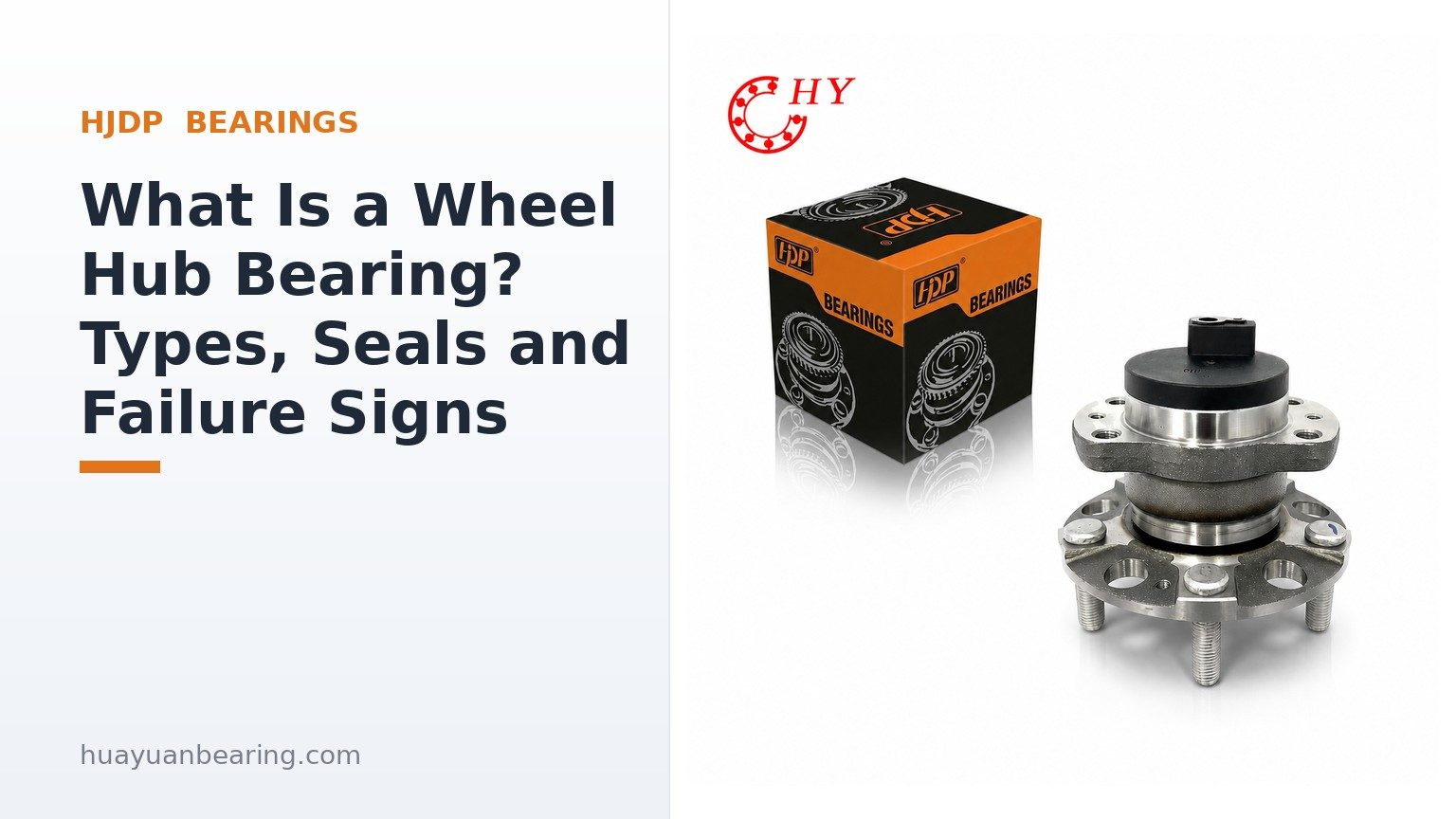
A wheel hub bearing is the sealed rolling bearing that carries vehicle weight and cornering load at the wheel while locating the brake disc and, on driven axles, the driveshaft. It sets wheel-end play, running noise and ABS signal quality. Modern cars use a unitized hub assembly — bearing, flange, races and encoder in one non-serviceable part — while older and heavier vehicles still use separate bearings and hubs. Correct selection depends on load direction, sealing and mounting geometry, not on a part number alone.
Jinan Huayuan Bearing Co., Ltd., at huayuanbearing.com, manufactures and exports wheel hub bearings, hub units, tensioners and CV joint components from Jinan, Shandong, for aftermarket and OE customers, mainly in the Middle East and Southeast Asia, with development from drawings and samples, custom packaging and private label.
What Is a Wheel Hub Bearing and What Loads Does It Carry?
A wheel hub bearing carries three load components at once, and that combined duty — not bore size — decides which design is correct.
The three loads at the wheel corner
Radial load comes from the weight carried by that corner of the vehicle. Axial load appears in cornering, when the tyre pushes sideways against the hub. A bending moment arises because the tyre contact patch sits offset from the bearing centre line, so the two rows load in opposite directions. A double-row bearing resists that moment by spreading the rows; a single-row bearing cannot, which is why it appears only where a separate opposed bearing takes the moment.
Catalogue load ratings describe the bearing alone. On a flanged hub unit, flange stiffness matters as much, because a flexible flange tilts the outer row and shortens seal and raceway life.
What else the hub bearing does at the wheel corner
- Locates the brake disc or drum, so flange runout becomes brake judder.
- Carries the ABS encoder ring and, on many Gen 3 units, the sensor itself.
- Seals the wheel end against water, brake dust and de-icing salt.
- Transmits drive torque through a splined bore on driven axles.
Sealed for life versus serviceable
Unitized hub assemblies are greased and sealed at manufacture and are not repacked in service; the whole unit is replaced. Separate tapered sets on older or heavy axles are serviceable: cleaned, inspected, repacked and set to a specified end play. Pressing a sealed unit apart to add grease, or fitting a serviceable pair without setting preload, causes most failures later blamed on the part.
What Are the Differences Between Gen 1, Gen 2 and Gen 3 Hub Units?
The generation number describes how much of the wheel end is built into the bearing: Gen 1 is a bearing only, Gen 2 adds one mounting flange, Gen 3 adds the studded wheel flange so the unit bolts to the knuckle and carries disc and wheel.
Generation 1: bearing only
Gen 1 is a double-row angular contact or tapered bearing pressed into a knuckle bore or axle housing, with the inner rings on a separate hub or stub axle. Fitting needs a press, correct seating and, for tapered designs, an end play or preload setting. Sealing is usually a separate cassette or lip seal. Gen 1 survives on older cars, trailers and light commercial axles because the surrounding parts are simple and the bearing alone can be replaced.
Generation 2: one flange
Gen 2 puts a flange on the outer ring for bolting to the knuckle, or on the inner ring to carry the disc. It removes the press fit and preload setting from the workshop and protects the seal inside a machined housing. Gen 2 is common on rear axles and non-driven front wheels. Where a catalogue number is ambiguous, how a wheel bearing differs from a complete hub assembly explains which type you are looking at.
Generation 3: the whole wheel corner
Gen 3 has a studded wheel flange on the inner ring and a bolt-on flange on the outer ring, locating disc, wheel and encoder in one sealed-for-life assembly, set to preload at manufacture. It dominates driven front axles on passenger cars and SUVs because it saves weight and knuckle machining. Because the encoder sits inside the seal, a Gen 3 unit must match on sensor type as well as on dimensions.
| Feature | Gen 1 | Gen 2 | Gen 3 |
|---|---|---|---|
| Integrated parts | Bearing only | Bearing plus one flange | Bearing, wheel flange, encoder, seal |
| Mounting | Pressed into knuckle or housing, separate hub | Bolted to knuckle or disc register | Bolted to knuckle, wheel bolts to unit |
| Preload or end play | Set during installation on tapered designs | Set at manufacture | Set at manufacture |
| Typical position | Trailer, older car, light commercial | Rear axle, non-driven wheel | Driven front and rear axles, SUV |
| Service action | Replace bearing, reuse hub | Replace unit | Replace unit, match sensor type |
Some catalogues use labels such as Gen 1.5 or Gen 2.5. Treat any generation label as a description rather than a standard, and confirm the arrangement on the drawing.
Which Internal Design Fits: Tapered Roller, Cylindrical Roller or Ball?
The rolling element decides how much radial load, axial load and moment a hub bearing can take inside a given envelope, so check it first after the mounting geometry.
Tapered roller bearings
Line contact along the raceway gives high radial capacity plus axial load in one direction, so tapered bearings are always used as an opposed pair. The pair can be set to a defined end play or preload, which tolerates shaft deflection and heavy duty. Tapered sets suit trailer hubs, light truck axles and older rear-wheel-drive front wheels. The cost is friction and adjustment: a badly set pair runs hot or rocks.
Cylindrical roller bearings
Cylindrical rollers give very high radial capacity in a compact section but carry little axial load without flanges, so the hub needs a separate thrust element. They suit applications where radial capacity dominates and axial location is provided elsewhere in the wheel end. On their own they are the wrong choice wherever axial load reverses.
Double-row angular contact ball bearings
Two ball rows on grooved raceways, with a contact angle of roughly 20 to 40 degrees, take combined radial and axial load in both directions plus the wheel-end moment, at lower friction than a tapered pair. That is why Gen 2 and Gen 3 units are almost always ball based. The penalty is sensitivity to impact and to seal damage.
Tensioner pulleys and CV joints
An automatic belt tensioner pulley uses a small sealed deep-groove or double-row ball bearing pressed into a pulley; its critical parameters are pulley offset, clearance and grease for continuous high speed, not wheel load. A CV joint transmits torque through balls held in a cage between inner and outer races, and its life depends on boot integrity and grease type. Both are drive components rather than wheel-support bearings, and importers often buy them alongside hub bearings.
| Design | Contact | Radial capacity | Axial capacity | Typical wheel-end use |
|---|---|---|---|---|
| Tapered roller, opposed pair | Line | High | High, one direction per row | Trailer, light truck, older rear-wheel-drive front |
| Cylindrical roller | Line | Very high | None without a separate thrust element | Heavy radial duty with location provided elsewhere |
| Double-row angular contact ball | Point | Moderate | Moderate, both directions | Gen 2 and Gen 3 passenger car units |
| Deep groove ball in tensioner pulley | Point | Low to moderate | Low | Belt tensioner and idler pulleys |
How Do You Read a Wheel Hub Bearing Drawing and Specification?
Read a hub bearing drawing in a fixed order: envelope and flange geometry first, then raceway and rolling element specification, then material and heat treatment, then clearance, sealing, grease and sensor features.
Envelope and flange geometry
Check overall height, flange diameter, bolt circle and hole count, stud thread, pilot diameter, disc register depth, spline or bore size, and the offset between wheel mounting face and knuckle face. One wrong offset moves the brake disc and changes wheel track. On driven units the spline form and the shoulder that seats the CV joint matter as much as the bearing.
Material and heat treatment
Races and rolling elements are normally through-hardening bearing steel such as GCr15 / 100Cr6 (SAE 52100 equivalent), or case-carburizing steel for impact-loaded designs. Flanges are forged or machined from medium-carbon or micro-alloyed steel. The drawing should state hardness, case depth where relevant, and surface protection. Steel quality behind hub bearing life is the largest single lever on fatigue life, and it is invisible in a finished part.
Precision grade, clearance and preload
Wheel-end bearings are typically specified to ISO 492 class P6 or P5, roughly ABEC-3 or ABEC-5 in the ABMA scheme. Clearance is given as a group — C2, C0 or C3 — for ball units, or as end play in millimetres for tapered pairs. A unitized hub is preloaded at assembly, so the control is running torque and axial play measured after assembly, not unmounted clearance.
Seals, grease and sensor features
The seal specification should name the type — integrated lip seal with dust lip, cassette seal, or seal carrier with encoder — plus grease fill, base oil viscosity and temperature range. On ABS units the encoder type and sensor air gap belong on the drawing, because identical dimensions can hide two incompatible sensor designs.
Checking a drawing before you order
- Confirm axle position, drive type and brake type from the vehicle, not from an old invoice.
- Compare envelope dimensions against the OE part, one dimension at a time.
- Confirm rolling element design and row arrangement.
- Confirm hardness, case depth and surface protection.
- Confirm clearance or preload and the acceptance limit after assembly.
- Confirm seal type, encoder type, grease and temperature range.
- Confirm marking, packaging and private-label requirements.
Used as a written wheel hub bearing RFQ checklist, these points show whether a supplier can repeat a part rather than match a sample once. Part numbers and OE references are confirmed against the drawing and the sample.
Confirming an incoming lot
Incoming inspection is dimensional and functional, not visual: measure flange diameter, bolt circle, offset, pilot diameter and spline; check thread; verify seal type and encoder presence; measure axial play or running torque on a sample; confirm markings and packaging match the purchase order.
How Do You Match a Hub Bearing to a Vehicle or Duty Cycle?
Match on four things before part number: axle position and drive type, axle load and duty cycle, brake and wheel geometry, and the ABS arrangement. A part number confirms a match; it does not make one.
Axle position and drive type
A driven front axle needs a splined bore and a seal that keeps grease in and water out at the CV joint interface; a non-driven rear axle usually needs a flanged unit without a bore. Trailer axles generally use separate tapered sets or a heavy flanged unit, depending on hub design. A part that fits but does not last has usually been chosen for the wrong axle type.
Load, duty cycle and environment
A city taxi, a loaded van, a towing vehicle and a gravel-road pickup load the same nominal bearing size very differently. Higher axle load, larger tyre diameter and higher offset all raise the moment at the bearing, so heavier duty should move the choice towards a tapered or larger double-row design, stronger sealing and, where available, a reinforced flange. Dust, standing water and road salt attack the seal first.
OE numbers and supersession
OE numbers are the fastest way to shortlist and the worst way to confirm. Numbers get superseded, several OE numbers can share one bearing, and one number can cover more than one variant. Treat a cross-reference as a candidate list, then confirm by dimensions, encoder type and sample. The notes on OE number and ABS fitment show how encoder variants break an otherwise correct lookup, and supersession management covers keeping a catalogue clean when numbers change. For the decision between replacing a bearing and replacing the assembly, the selection guide for wheel bearings and hub assemblies sets out the trade-offs. Fitment is always confirmed against the drawing and the sample.
How Should a Wheel Hub Bearing Be Installed and Replaced?

Installation decides a large share of hub bearing life, because most early failures come from pressing the wrong race, reusing a stretched nut or contaminating a sealed unit.
- Confirm the fault first: identify which corner is noisy or loose, and check tyre, brake and suspension before condemning the bearing.
- Raise and secure the vehicle, remove the wheel, and release the driveshaft nut or axle bolt before lifting the caliper.
- Support the caliper and disc so the brake hose carries no load, then remove the disc to expose the unit.
- Disconnect the ABS sensor connector where fitted; never pull a unit out by its sensor lead.
- Remove the mounting bolts or retaining ring and withdraw the unit with a puller acting on the flange, not on the outer ring.
- Clean the knuckle bore and flange face, remove corrosion and burrs, and check the bore for out-of-round.
- Fit the new unit square to the bore, press or draw it in on the outer ring only, and torque fasteners in sequence with new bolts where specified.
- Refit disc and caliper, torque the driveshaft nut to specification, reconnect the sensor, and check for play and noise on a road test.
Two rules prevent most comebacks: never transmit press force through the balls or rollers, and never reuse a torque-to-yield axle nut. Kits differ in content, so check the box before quoting a repair; the breakdown of wheel hub bearing kit contents lists what is often supplied separately.
Separate bearing or complete unit?
Replace the complete unit when the flange, studs or encoder ring are part of the failed assembly, when the knuckle bore is damaged, or when the vehicle was built with a sealed unit. Replace only the bearing where the design allows it and the hub shoulder and spindle are within tolerance.
Why Do Hub Bearings Fail, and How Do You Confirm the Cause?
Most wheel hub bearing failures trace back to seal damage, fitting error or impact rather than to the steel itself, and the wear pattern usually shows which.
| Failure pattern | Usual cause | What you see |
|---|---|---|
| Grey or emulsified grease | Seal lip damage or missing dust lip | Rust on raceways, water in grease |
| Local spalling on one side of a raceway | Impact during fitting or road damage | Single spall, brinelling spaced to ball pitch |
| Even wear with discolouration | Grease breakdown, overheating | Blue or brown tint, hardened grease |
| Play at 12 and 6 o'clock | Incorrect preload or worn hub shoulder | Axial play above specification |
| ABS light with a new unit | Wrong encoder type or air gap | No signal or intermittent signal |
| Stepped or grooved raceway | Contamination through a worn seal | Debris embedded in grease |
Noise is the least specific symptom: tyre roar, a worn CV joint and a bent brake shield can all sound like a bearing. Load the corner, change direction and listen for the side that changes with load; a bearing usually gets louder when the loaded side is on the outside of a turn. How to tell a wheel hub bearing is failing sets out the check sequence, and wheel hub bearing noise diagnosis separates bearing noise from tyre and driveline noise. Replace when play or roughness is measurable, or when the seal has failed — not on noise alone.
Frequently Asked Questions About Wheel Hub Bearings
What is the difference between a wheel bearing and a wheel hub bearing?
A wheel bearing is the rolling element set on its own. A wheel hub bearing is that set built into a hub with a flange, seal and usually an encoder ring, so it can be bolted on as one part. Unitized hubs are sealed for life and replaced as a unit; separate bearings are serviced. Fitment is confirmed against the drawing and the sample.
Which generation of hub unit should an importer stock?
Stock by vehicle parc, not by generation alone. Gen 3 units cover most driven front axles of recent passenger cars and SUVs and carry the highest return risk if the encoder type is wrong. Gen 1 and Gen 2 stay relevant for older cars, trailers and rear axles. Build the range from a fitment list and confirm each reference on drawing and sample.
Can a wheel hub bearing be re-greased or repaired?
Not in practice. Unitized hub bearings are sealed at manufacture and have no serviceable grease path; opening one destroys the seal and the preload setting. Separate tapered sets can be cleaned, inspected and repacked, provided races and rollers show no pitting or discolouration. Once play or roughness is measurable, replacement is the only reliable repair.
Does Huayuan Bearing develop hub bearings from drawings and samples?
Jinan Huayuan Bearing Co., Ltd. at huayuanbearing.com develops wheel hub bearings, hub units, tensioners and CV joint components from customer drawings and samples, and supports custom packaging and private label. Buyers are mainly in the Middle East and Southeast Asia, in aftermarket and OE supply. References and fitment are confirmed against the drawing and the sample before production.
Purchasing guidance, product information and company updates from Huayuan Bearing.