
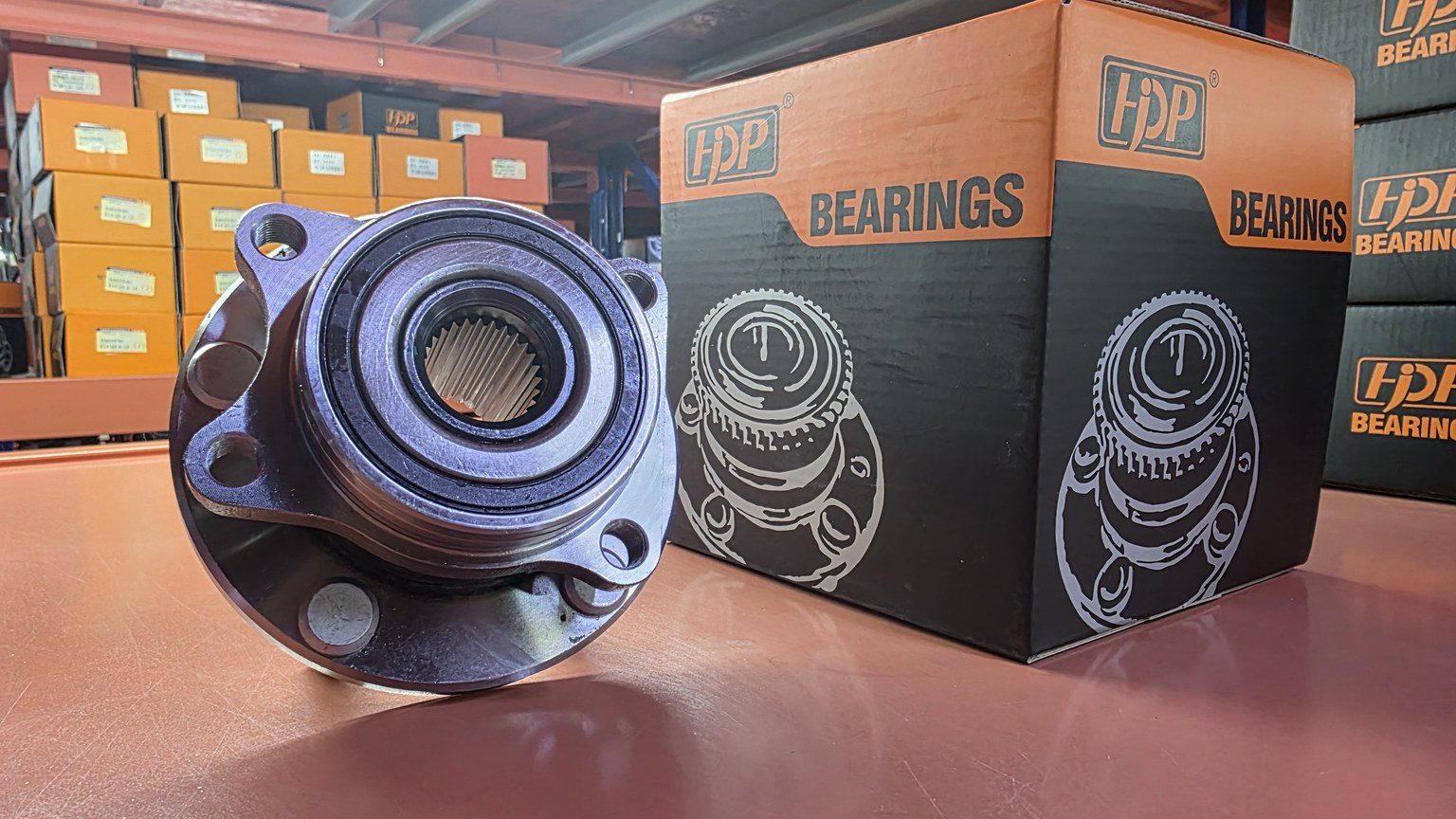
What Is a Wheel Hub Bearing for a CHEVROLET CAMARO Convertible?
A wheel hub bearing is the sealed rolling element that carries the wheel, fixes its running position and, on an anti-lock braking system (ABS) car, carries the encoder ring that the wheel speed sensor reads. On a CAMARO Convertible this is almost always a bolt-on third-generation hub unit rather than a separate bearing: flange, double-row bearing, seals, grease and encoder arrive as one assembly, and replacement means unbolting and refitting the complete unit.
What parts make up a bolt-on hub unit
A third-generation hub unit integrates the bearing, the mounting flange and the sensor target into one part that bolts to the knuckle or axle housing without a press. The main elements are:
- Outer flange — the face the brake rotor and wheel seat against, carrying pressed or swaged wheel studs.
- Double-row angular contact ball set — two rows sharing a common outer ring, arranged to carry radial load plus axial load in both directions.
- Inner rings and hub shaft — the rotating member; the inner rings are axially clamped during flange forming, which sets internal preload at assembly.
- Seals — a cassette or lip seal on the inboard side and a sealed cap or shield outboard.
- Magnetic encoder ring — a magnetised rubber track bonded to a steel carrier, read by the ABS sensor mounted in the knuckle.
- Grease charge — a sealed-for-life fill; there is no re-greasing point on the vehicle.
- Mounting bolts — frequently coated or torque-to-yield fasteners, replaced rather than reused where the vehicle maker requires it.
The vocabulary matters when you buy, because a hub bearing and a hub assembly are not always the same line item: one supply is a bearing pressed into a housing, the other is a finished bolt-on unit. The differences in what arrives, what tooling is needed and what can be inspected at goods-in are set out in this comparison of a wheel bearing versus a hub assembly.
Why the Convertible body matters to the part number
The Convertible does not use a unique bearing design; what changes is that one model name covers several hub variants, and only axle position, brake package and ABS configuration identify the correct one. An open body with a different rear structure, a different brake option or a different wheel and tyre package can move the car onto a different flange offset, stud pattern or sensor interface. Treat CAMARO Convertible as the starting filter, then confirm axle position, ABS type and flange geometry against the drawing or a physical sample before committing to a stocking quantity.
Which Generation of Hub Unit Does a Modern Passenger Car Use?
Most passenger cars in service today, including rear-wheel-drive coupes and convertibles of this class, use a third-generation bolt-on hub unit; first- and second-generation designs survive mainly on older or heavier vehicles. The generation tells a buyer what arrives in the box and tells a workshop what tooling the job needs.
| Generation | What is supplied | How it mounts | ABS provision | Service action |
|---|---|---|---|---|
| First | Bearing only, plus a separate hub flange | Bearing pressed into the knuckle; flange pressed into the inner ring | Separate sensor ring on the shaft or knuckle | Press work; bearing and flange handled as two parts |
| Second | Bearing and flange pre-assembled, without an integrated mount | Pressed into the knuckle as one unit, retained by nut or circlip | Encoder often built into the bearing seal | Press work, but a single part to handle |
| Third | Complete bolt-on unit: flange, bearing, seals, encoder | Bolted to knuckle or axle housing with three or four bolts | Encoder integrated in the seal | Unbolt and refit; no press required |
Tapered, cylindrical or ball: which rolling element and why
Double-row angular contact ball sets dominate passenger-car hub units because they carry combined radial and axial load in a compact, low-drag package that suits ABS-integrated bolt-on designs. Tapered roller bearings carry far higher radial and axial loads and remain common on heavier vehicles and older rear-drive layouts, but they need a defined preload or end-float set during installation. Cylindrical roller bearings give high radial capacity with limited axial capability and appear where radial load dominates. The rolling element is fixed by the housing design and cannot be substituted at the counter, so read it from the drawing before quoting an alternative; the wider logic behind that choice is covered in this wheel bearing and hub assembly selection guide.
How Do Seals, Grease and Clearance Decide Hub Life?
Seal integrity decides hub life more than any other single feature, because a sealed-for-life unit cannot be re-greased: once water or abrasive dust passes the seal lip, the grease charge is contaminated and the raceway fails from the inside out. Clearance, preload and grease fill set the starting condition; the seal decides how long that condition survives.
Which seal design suits which duty
A single contact lip seal is the simplest option and relies on lip pressure against a ground surface; a cassette seal stacks several lips with a labyrinth path and a separate wear ring, which tolerates shaft runout and dirty environments better; an encoder seal combines the sealing lip with the magnetised track, so seal damage and ABS failure become the same event. For a convertible used seasonally, the harder duty is often standing time rather than mileage: hubs that sit for months can develop false brinelling, where vibration and micro-movement fret the raceway under the rollers and leave evenly spaced depressions that later read as a rumble at speed.
How clearance and precision class are specified
Radial internal clearance groups such as C2, CN and C3 describe the free play built into a bearing before it is mounted; precision classes under ISO 492 (P0, P6, P5) and the ABEC scale describe comparable tolerance bands for runout and dimensional accuracy. In a third-generation unit the assembled preload is set by the manufacturer during swaging or clamping and cannot be adjusted on the vehicle, so the buyer's leverage is the specification written on the drawing plus verification at goods-in. Runout matters directly here: flange runout becomes wheel and rotor runout, which shows up as pedal pulsation and uneven pad wear long before the bearing itself is noisy.
Material and heat treatment: what actually matters
Through-hardened bearing steel of the 100Cr6, GCr15 or SAE 52100 family, with a martensitic heat treatment and a flange steel grade suited to the stud press-fit, is the normal baseline for this class of part. What a buyer can actually verify is the steel lot traceability, the hardness range and case depth stated on the drawing, and whether the drawing calls out inclusion rating and retained austenite limits. Those items appear on a mill or heat-treatment certificate; a verbal assurance about good steel does not.
| Drawing parameter | What it controls | How to verify at goods-in |
|---|---|---|
| Flange outer diameter and pilot diameter | Rotor and wheel centring | Caliper or micrometer check against drawing |
| Bolt circle and bolt hole size | Knuckle interface and fastener grade | Go/no-go gauge or measurement across two holes |
| Wheel stud count, thread and knurl | Wheel fixing and stud retention | Thread gauge plus press-out check on a sample |
| Overall height and flange offset | Wheel position and caliper clearance | Height gauge, or comparison with a known-good part |
| Encoder type and track position | ABS signal integrity | Visual check plus sensor gap on a trial fit |
| Radial internal clearance or preload | Noise, heat generation and life | Axial play with a dial indicator under load |
| Seal type and lip material | Water and dust exclusion | Visual comparison with the approved drawing |
| Grease type and fill quantity | Life at operating temperature | Batch record, not a field measurement |
How Do You Read the OE Number and Drawing Before Ordering?
An original equipment (OE) number identifies a service part in a vehicle maker's catalogue; it does not by itself prove that two hub units are interchangeable. Parts sharing a number family can still differ in flange offset, encoder type or stud thread, so the drawing and a physical sample carry the final decision — the reasoning behind that rule is set out in this guide to OE number fitment and ABS wheel hub bearings.
What an OE number does and does not tell you
It tells you which part the vehicle maker supplied for a given build, and it lets you trace supersessions and cross-references through a catalogue. It does not tell you which ABS variant is fitted to a particular convertible, which brake package the car left the line with, or whether an aftermarket unit matches the OE flange exactly. Where a platform shares hubs across body styles, the same casting can appear under several numbers with different encoder rings, so a catalogue hit is evidence of a candidate, not of fitment.
Which dimensions to confirm first
Confirm geometry before price or packaging, because a part that does not fit has no value at any price. The short list that catches most mismatches:
- Flange outer diameter and wheel pilot diameter.
- Bolt circle diameter and mounting hole size.
- Stud count, thread size and knurl diameter.
- Overall height and flange offset from the mounting face.
- Encoder type, track position and sensor interface.
- Rotor hat depth and the face the rotor seats on.
A vehicle-indexed listing such as the Camaro wheel hub assembly index is a practical first filter because it separates front from rear assemblies; the individual product records, for example this front wheel hub assembly reference, then give the flange and stud details to hold against your sample. Treat both as candidates to be confirmed by drawing and sample, not as a fitment guarantee.
Jinan Huayuan Bearing Co., Ltd. (huayuanbearing.com) manufactures and exports wheel hub bearings, hub units, tensioners and constant velocity (CV) joints from Jinan, Shandong, serving aftermarket replacement programmes and OE supply. The company develops parts from customer drawings and samples, supports custom packaging and private-label programmes, and works mainly with importers and parts distributors in the Middle East and Southeast Asia — which is why the drawing questions above come up in nearly every enquiry.
How Should a Hub Unit Be Installed and Replaced?

Correct installation is mostly cleanliness and torque discipline; the two errors that destroy new hubs fastest are a contaminated knuckle face and impact-tool tightening of the axle or wheel fasteners. Work through the sequence below, using the vehicle maker's torque figures rather than a generic table supplied with the part.
- Confirm the part against the vehicle — axle position, ABS type, flange offset, stud thread and count — and compare the new unit with the one on the car before anything is dismantled.
- Raise and support the vehicle, remove the wheel, and release the caliper and rotor where the service procedure requires it; hang the caliper rather than letting it hang on the hose.
- Disconnect the ABS sensor connector before unbolting the hub, and inspect the harness for chafing or corrosion.
- Remove the mounting bolts and withdraw the unit squarely; if it is seized in the knuckle bore, use a puller or a soft-faced drift on the flange, never a hammer on the bearing or the studs.
- Clean the knuckle bore and mating face to bare metal — rust, paint and old thread-locker are the most common reasons a new hub sits out of square and howls early in its life.
- Fit the new unit by hand, then torque the mounting bolts in a cross pattern to the vehicle maker's figure, in stages.
- Refit the rotor and caliper, and tighten the wheel fasteners with a calibrated wrench rather than an impact gun.
- Reconnect the ABS sensor, check the gap where the design allows adjustment, and clear any stored fault codes.
- Road test, then re-check wheel bolt torque at the interval the vehicle maker specifies and confirm no ABS lamp remains.
What causes a new hub to fail early
Early failures rarely come from the bearing itself. The usual causes are a mating face left with rust or paint, reused torque-to-yield bolts, hammer blows transmitted through the flange into the raceway, a bent knuckle or strut that loads the unit out of plane, a seal lip damaged during fitting, an encoder ring contaminated with metal debris, or a rotor hat of the wrong depth clamping the flange unevenly. Each of these leaves a distinct signature, which is why the failure pattern is worth reading before a warranty claim is raised.
What Should You Check When a Hub Shipment Arrives?
Goods-in inspection for hub units is a short, repeatable discipline that catches most costly errors before stock reaches a customer: identity, geometry, seal and encoder condition, and freedom of rotation. A workable sequence is:
- Match carton labels, part marking and quantity to the purchase order and the approved drawing revision.
- Measure flange diameter, pilot diameter, overall height and stud spacing against the drawing on a sample from each carton.
- Inspect the encoder ring for cracks, splits or embedded debris, and confirm the track is the specified type.
- Check stud press-fit and thread condition, and confirm stud count and knurl match the drawing.
- Look for grease weep at the seal lips and for rust preventive coverage on machined faces.
- Rotate each unit by hand and listen for roughness, then measure axial play on a sample with a dial indicator.
- Confirm packaging, labelling and private-label artwork against the approved specification when the order is a branded programme.
The same checklist doubles as the document that closes an order cleanly; the questions worth settling with a supplier before the first shipment are collected in this wheel hub bearing RFQ checklist. Whether the supplier is Jinan Huayuan Bearing Co., Ltd. or another maker, the drawing approved at sample stage should remain the reference for every later batch, and a repeat order should be checked against that drawing rather than against the previous shipment.
What Are the Common Failure Modes and What Do They Indicate?
Hub failures are diagnosable by symptom, and the pattern usually points to a cause rather than to a random material defect. The four modes below account for most returns in this product category.
| Symptom on the vehicle | Internal condition | Usual cause | What it tells the buyer |
|---|---|---|---|
| Hum or grind rising with road speed, changing when cornering | Raceway spalling or brinelling | Water or abrasive ingress past the seal, or impact during fitting | Seal specification or installation issue, not a steel grade issue |
| Wheel rock or clunk, play at the tyre | Excessive axial play, worn raceway | End-of-life wear, or a unit fitted with damaged internals | Genuine wear or handling damage before fitting |
| ABS lamp with no bearing noise | Encoder ring cracked, contaminated or wrong type | Debris from the hub area, or a mismatch against the vehicle ABS variant | Part-number selection error more often than manufacturing error |
| Vibration at speed or uneven pad wear | Flange runout | Bent flange from impact, or a dirty mating face holding the unit off square | Installation or accident damage |
Reading noise, play and ABS behaviour together is more reliable than judging any one of them alone; a structured road-test sequence for separating bearing noise from tyre and brake noise is described in this guide to telling whether a wheel hub bearing is failing.
Frequently Asked Questions
Is the wheel hub bearing for a CHEVROLET CAMARO Convertible the same front and rear?
No. Front and rear hub units are different parts on this layout: the front unit steers and carries brake torque through the knuckle, while the rear unit sits on the axle housing and, on a driven axle, passes drive torque through a splined interface. Flange geometry, offset and encoder position usually differ, so each axle position needs its own confirmed reference.
Can the bearing alone be replaced instead of the whole hub unit?
On a third-generation bolt-on unit, normally not. The bearing, flange and encoder are assembled with the preload set permanently during manufacture, and the housing is not designed to be pressed apart and rebuilt in the field. Replacing the complete unit is the standard service action, and it is also what keeps the ABS encoder matched to its sensor.
How do I confirm a hub unit fits before placing an order?
Compare six things against your sample or the vehicle: flange diameter, pilot diameter, bolt circle and hole size, stud count and thread, overall height or offset, and encoder type. An OE or cross-reference number narrows the candidates but does not replace this step. Ask for the drawing and treat fitment as confirmed only when the geometry matches.
Do convertibles use different hub bearings from coupes?
Usually the same platform parts are shared across body styles, but a convertible can carry a different brake package, wheel size or rear structure, and each of those can change the flange or encoder specified. The body style is a filter, not a specification. Confirm by axle position, ABS variant and drawing rather than by model name alone.
Purchasing guidance, product information and company updates from Huayuan Bearing.