
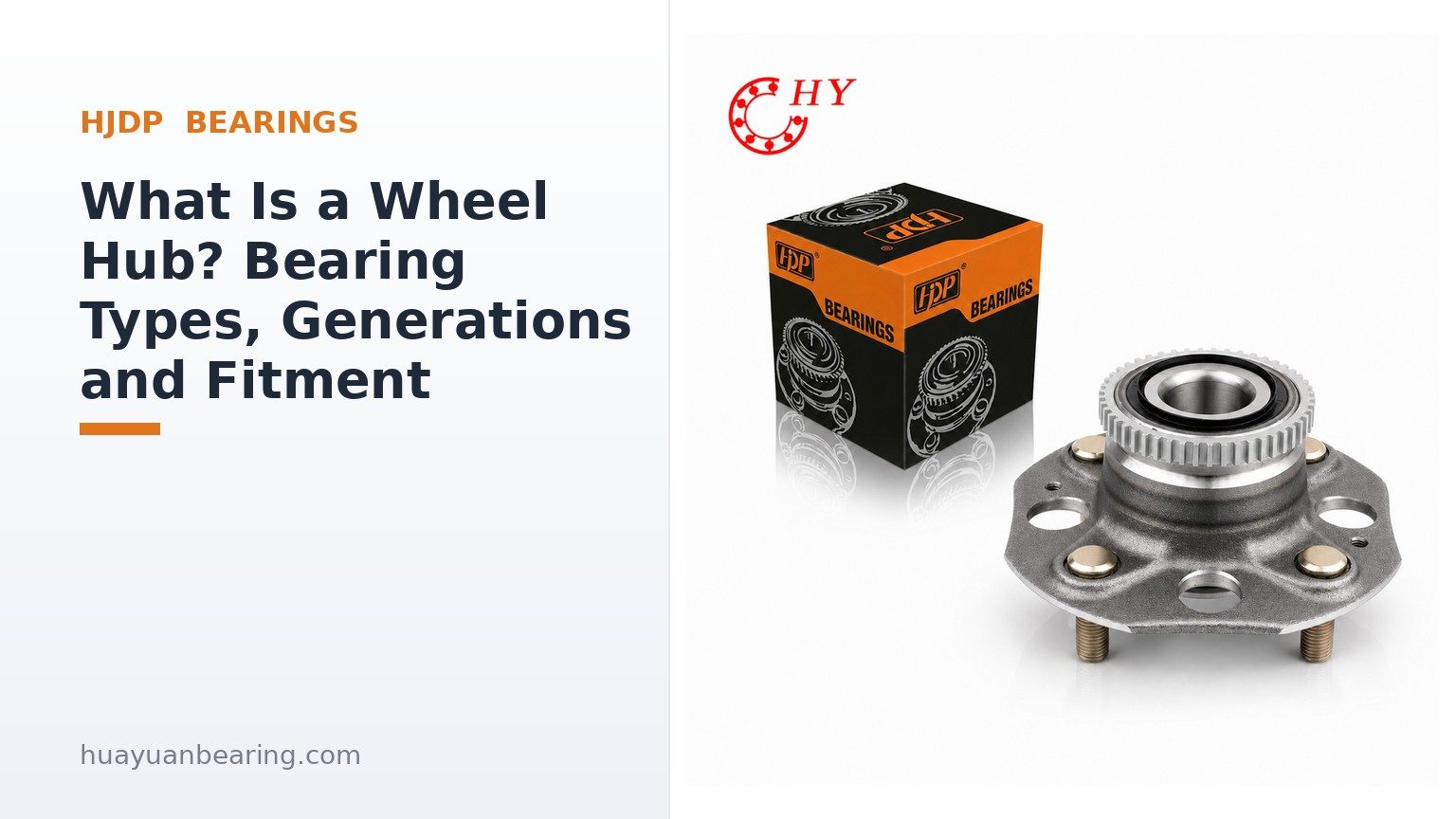
A wheel hub is the rotating assembly that mounts the wheel to the axle, and the wheel hub bearing inside it carries the vehicle's weight and cornering forces while letting the wheel turn. On most vehicles built since the late 1990s, bearing, hub flange, studs and ABS interface are combined into one sealed unit, so the same term covers a bare bearing, a flanged bearing and a complete hub assembly. Jinan Huayuan Bearing Co., Ltd. (huayuanbearing.com) manufactures and exports all three for aftermarket and OE supply, and this guide explains how they differ and how to specify them.
What Is a Wheel Hub and What Does It Consist Of?

A wheel hub is the rotating assembly that connects the wheel to the suspension, and it performs four jobs at once: it locates the wheel, carries vertical and cornering load into the knuckle or axle housing, provides the mounting face and stud circle for the wheel, and on most modern cars houses the ABS sensor interface. Because those jobs can be packaged in different ways, the same term covers products that range from a bare bearing to a fully assembled unit with studs and electronics.
The parts inside a hub unit
Every hub unit contains the same functional elements, whatever its generation:
- Outer ring — the stationary raceway, carrying either a press-fit diameter or a bolt flange, and often the sensor bore.
- Inner ring or rings — the rotating raceways; a split inner ring allows a two-row bearing to be assembled with controlled clearance or preload.
- Rolling elements and cage — balls, tapered rollers or cylindrical rollers, retained by a polyamide or steel cage.
- Seals — usually multi-lip NBR or PTFE lip seals; on ABS hubs the encoder is moulded into the seal or fitted to the inner ring.
- Grease — a lithium-complex or polyurea grease selected for the operating temperature range and filled once, for life.
Why most hubs cannot be serviced
Passenger-car hub units are sealed for life: there is no grease nipple, no adjustment and no rebuild procedure, so the seal is effectively the service-life component. Truck, trailer and some light-commercial hubs still use serviceable tapered roller bearings with separate cups and cones, adjustable end play and a grease cavity. The two must not be treated alike — a sealed unit cannot be topped up, and an adjustable hub cannot be set by feel.
Three products share the name
A wheel bearing is the bearing alone; a hub unit adds an integrated flange; a hub assembly adds studs, encoder or sensor and mounting hardware. The difference between a wheel bearing and a hub assembly changes both part cost and labour time, and the wheel hub bearing and hub unit range published on huayuanbearing.com follows the same three-way split.
Which Wheel Hub Bearing Generation Do You Need: 1, 2 or 3?
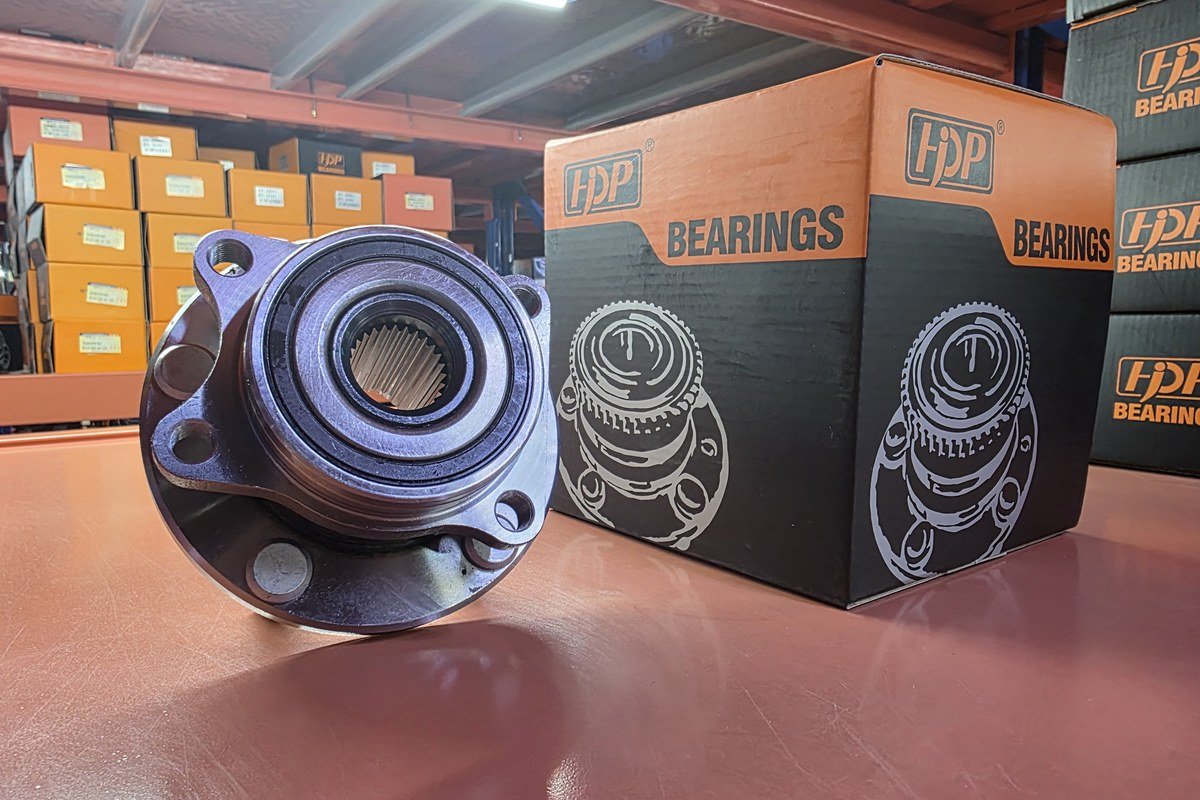
Generation numbers describe how much of the hub is integrated into the bearing, not its quality: Gen 1 is a bearing, Gen 2 adds a flange to the outer ring, and Gen 3 adds the wheel-mounting flange, the studs and usually the ABS encoder.
| Generation | What is integrated | Typical bearing design | ABS interface | Installation |
|---|---|---|---|---|
| Gen 1 | Bearing only, no flange | Double-row angular contact ball, or paired tapered rollers | Usually none; encoder added on some variants | Pressed into knuckle or onto stub axle, retained by circlip |
| Gen 2 | Bearing plus flange on the outer ring | Double-row angular contact ball or tapered roller | Encoder often integrated on the inboard side | Bolted or pressed into the knuckle; original hub or stub axle used for wheel mounting |
| Gen 3 | Bearing, hub flange, studs and encoder | Double-row angular contact ball, factory-set preload | Magnetic encoder or sensor bore integrated | Bolted to the knuckle with three or four bolts; no press work |
Generation 1: the bearing alone
Gen 1 is a double-row bearing pressed into the knuckle or onto a stub axle and retained by circlips or a shoulder. It is the lowest-cost option and the most demanding to install, because the hub and knuckle themselves provide the mounting face and the sealing surfaces. Typical fitment is older passenger cars, non-driven rear axles and light trailers, and replacement normally requires a press and dedicated drivers.
Generation 2: flanged outer ring
Gen 2 carries a flange on the outer ring, which locates the unit positively in the knuckle and adds stiffness. Many Gen 2 units place the encoder on the inboard side and use the original hub or stub axle for wheel mounting. Fitment is common on rear axles, and on front axles of vehicles that retain a separate hub.
Generation 3: complete unit
Gen 3 is a single bolt-on assembly: bearing, hub flange, studs and encoder in one sealed unit, usually held by three or four bolts from the inboard side. It removes press work from the repair, which is why most passenger-car and light-SUV front axles now use it. It is also the generation where ABS variants multiply, because one axle can carry different sensor types, brake sizes and market-specific equipment.
Check the ABS interface before ordering
The encoder is the most frequently mismatched feature of a wheel hub. A rubber-bonded magnetic encoder working with an active sensor is not interchangeable with a toothed steel ring working with a passive inductive sensor: pulse count, air gap and sensor depth all differ. A hub that bolts up correctly but signals incorrectly can disable ABS and stability control, so the vehicle's sensor type must be confirmed against the drawing and a physical sample, not only against an interchange list. The guide to OE numbers and ABS fitment explains how part numbers map to those variants.
Which Rolling Element Fits Your Load: Tapered, Cylindrical or Ball?
The rolling element sets radial capacity, axial capacity and the way a bearing must be adjusted: balls suit light, fast passenger-car duty, tapered rollers suit combined loads in serviceable hubs, and cylindrical rollers suit high radial load in heavy-vehicle hubs.
| Design | Load direction | Adjustment | Typical position |
|---|---|---|---|
| Double-row angular contact ball | Radial plus moderate axial in both directions | Preload or clearance set at assembly; not adjustable in service | Gen 1, 2 and 3 passenger-car and light-SUV hubs |
| Tapered roller, paired | High radial and high axial in one direction per row | End play or preload set by nut or shims | Non-driven front axles, trailers, light trucks, some rear axles |
| Cylindrical roller | Very high radial, minimal axial | Clearance set at assembly; axial location from a separate element | Heavy truck and bus hub units |
| Deep groove ball (pulley) | Radial plus light axial from belt pull | Factory sealed, no adjustment | Tensioner and idler pulleys |
Tapered roller bearings in serviceable hubs
Tapered rollers make line contact on inclined raceways, so one row carries radial load together with axial load in one direction; two rows mounted face to face or back to back handle both directions. They tolerate shock well but depend on correct end play and clean grease, and an over-tightened adjusting nut will destroy them faster than wear will.
Double-row angular contact ball bearings
Two rows of balls on inclined raceways, set to a defined clearance or preload at assembly, give low friction and low weight in a compact envelope, which is why they dominate passenger-car hubs. They are sensitive to impact denting and to contamination, and they cannot be re-adjusted once the seal is closed.
Cylindrical roller bearings for heavy duty
Cylindrical rollers give high radial capacity in a narrow section but almost no axial capacity, so a heavy hub unit pairs them with a separate thrust arrangement. They suit duty cycles where payload, not cornering speed, sets the load.
Tensioner pulley bearings: a different duty cycle
A tensioner pulley carries belt tension rather than vehicle weight, and it turns continuously at engine speed. Structurally it is a sealed deep groove ball bearing pressed into a stamped or cast pulley, often offset or eccentrically mounted. Failure appears as a chirp or squeal at cold start, belt dust around the pulley, or visible wobble. Because the bearing is rarely replaceable on its own, the pulley is sold as an assembly and is normally changed with the belt and tensioner arm.
CV joints next to the hub
A constant velocity joint — the ball-cage joint listed as 球笼 in Chinese catalogues — is not a hub bearing: it transmits drive torque at a variable angle. Its structure is an inner race on the shaft, an outer race in the joint housing, six balls held in a cage, and a boot that retains grease. The hub bearing still carries the vehicle's weight; the CV joint carries torque. Diagnosis differs too: clicking on full lock and a split boot point to the joint, while a hum that changes with steering load points to the hub bearing.
How Do Material, Heat Treatment, Clearance and Sealing Decide Service Life?
Four specification decisions set the life of a wheel hub: steel cleanliness and heat treatment, raceway geometry and precision grade, internal clearance or preload, and the seal and grease package.
Steel grade and heat treatment
Rings and rolling elements are typically made from through-hardening bearing steel — GCr15 in Chinese standards, 100Cr6 in European standards, SAE 52100 in US standards — hardened and tempered to roughly 58 to 64 HRC, with tempering chosen so the part stays dimensionally stable in hot climates. Some hubs use induction-hardened or case-hardened raceways with a defined case depth and a tougher core, which resists the impact denting that follows pothole strikes. Cleanliness matters as much as hardness: non-metallic inclusions start the subsurface cracks that eventually spall a raceway.
Precision grade and internal clearance
Running accuracy is classified by ISO 492, broadly comparable to ABEC 1 through ABEC 5, and automotive hub units are commonly produced to normal or P6 class. Internal clearance in a sealed hub is not a field adjustment, but it still has to be specified: ISO 5753 groups such as C2, CN, C3 and C4 define the range. Excess clearance produces play, noise and uneven tyre wear; excess preload produces heat, grease breakdown and early fatigue.
Seals, encoders and grease
Sealing decides aftermarket life more than any other feature. A single lip excludes dust, but water crossings, pressure washing and road salt call for multi-lip or labyrinth seals, because a worn lip admits grit that turns the grease into an abrasive paste. Encoder seals must also hold the magnetic track flat and at the correct air gap. Grease fill is calculated rather than maximised, since overfilling churns the grease and raises running temperature.
How to read the parameters on a drawing
A hub drawing carries more than boundary dimensions, and every line has a purpose when a part is quoted or tooled:
| Parameter on drawing | What it controls | What to confirm |
|---|---|---|
| Boundary dimensions d, D, T or B | Fits the knuckle bore, stub axle and wheel offset | Tolerance class and measuring method |
| Flange PCD, bolt count, spigot diameter | Wheel and brake location, stud pattern | PCD, thread size, stud knurl, spigot tolerance |
| Encoder type, pulse count, sensor bore | ABS and stability control signal | Active or passive sensor, air gap, track width |
| Internal clearance or preload | Running temperature, noise, play | Clearance group or measured preload value |
| Seal design and lip material | Water, dust and pressure-wash resistance | Number of lips, NBR or PTFE, encoder integration |
| Marking and traceability note | Batch identification for claims | Marking position and code format |
Where Is a Wheel Hub Fitted, and Which Loads Define the Specification?
A hub sits at each corner of the vehicle between the knuckle or axle housing and the wheel, so its specification follows from the loads and the environment at that corner rather than from the vehicle's size alone.
Front and rear, driven and non-driven
On a front driven axle the hub must pass the CV joint shaft through its centre and seal around it; on a non-driven front axle a paired tapered roller bearing or a Gen 2 hub on a stub axle is still common; rear axles with drum brakes often use a simpler flanged bearing, while rear driven axles resemble the front layout. Each position implies a different seal and encoder arrangement, which is why one vehicle can list several hub numbers.
Four load cases a hub must survive
- Vertical load — kerb weight plus payload, split between corners and transferred sideways in a turn.
- Cornering load — lateral force plus a bending moment on the flange; the outer wheel in a turn is the most heavily loaded.
- Braking and drive torque — reacted through the flange and studs as well as the raceways.
- Impact — potholes and kerb strikes dent raceways and brinell rollers, so a hub can fail soon after a single event with no wear history.
Conditions that change the specification
Dust and sustained heat, typical of Middle East markets, push seal material and grease choice toward higher temperature grades and better exclusion. Humidity, standing water and unpaved roads, typical of Southeast Asia, put the priority on multi-lip sealing and protected surfaces. Heavy payload, taxi duty, towing and large-offset wheels all raise load or bending moment and should be quoted as such rather than treated as a standard application. Jinan Huayuan Bearing Co., Ltd. supplies wheel hub bearings, hub units, tensioners and CV joints to aftermarket and OE customers, mainly in the Middle East and Southeast Asia, and develops parts to a drawing or a sample when no catalogue number covers the application.
How Do Wheel Hubs Fail, and How Do You Confirm the Failure Mode?
Most in-service hub failures start at the seal or at installation rather than in the steel: water and grit enter, the grease breaks down, and the raceway spalls thousands of kilometres later.
Use load direction to identify the noisy side
A worn hub bearing hums or growls in proportion to road speed, and the pitch follows vehicle speed rather than engine speed. Loading one side identifies it: in a gentle lane change or sweeping curve, the bearing that gets louder when its corner is loaded on the outside of the turn is the suspect. Confirm the diagnosis by checking that the noise persists while coasting in neutral, and rule out tyre roar, a brake disc shield or a trapped stone.
Play, runout and ABS warnings
With the wheel raised, check for play at 12 and 6 o'clock and at 3 and 9 o'clock, then measure lateral runout on the hub face with a dial indicator against the OEM limit. Play combined with an ABS warning on the same corner often indicates an encoder or air-gap problem rather than a mechanical failure, so read the fault code before condemning the hub.
Failure modes and what they look like
- Water ingress — rusty or emulsified grease, pitted raceway, damaged seal lip.
- False brinelling — evenly spaced marks from long standstill or transport vibration, common in stock that sat or travelled far.
- Impact brinelling — a single dent with a matching mark on the roller, from a pothole or kerb strike.
- Spalling — flaking that starts below the surface, usually after contamination or overload.
- Installation damage — rolled seal lip, deformed cage or cracked inner ring from pressing on the wrong ring.
- Over-torque or wrong preload — discoloured raceway and darkened grease from heat.
Recording the failure mode per return, not just the part number, is what makes warranty data usable; the warranty return data checklist for wheel hubs sets out what to log. The symptoms of a failing wheel hub bearing are covered step by step in a separate road-test guide.
How Do You Install and Inspect a Replacement Wheel Hub?

Correct installation preserves the clearance, seal position and encoder air gap built into the hub, and most repeat failures trace back to pressing on the wrong ring, reusing the axle nut or omitting the seal protector.
- Clean the knuckle bore and stub axle, removing rust, old retaining compound and any remnant of the previous race.
- Check the bore for scoring or out-of-round; a damaged bore tilts the new unit and destroys its seal.
- Press on the inner ring when fitting a Gen 1 bearing to a shaft, and on the outer ring when fitting into the knuckle; never transmit press force through the rolling elements.
- Never hammer a hub into place — use the correct driver or the old outer ring as an installation tool.
- Fit a new axle nut and circlip where specified, since most designs treat them as single-use fasteners.
- Torque to the OEM figure with a calibrated wrench, holding the flange so the bearing does not take the torque reaction.
- Check runout on the hub face with a dial indicator, and confirm the encoder is clean and at the specified air gap.
- Road test at low speed in both directions and confirm no ABS warning before the vehicle is released.
Receiving inspection at the warehouse
Incoming checks catch most transit and storage damage before a unit reaches a workshop:
- Carton and unit labelling match the purchase order and the drawing revision.
- No rust on the flange face, studs or raceway, and protective oil still present.
- Seal lips undistorted, encoder track flat and unscratched, sensor bore free of swarf.
- Studs present, straight and correctly staked; splines undamaged.
- Sample dimensional check of flange PCD, spigot diameter and overall height.
- Batch code recorded against the delivery note.
Storage matters as much as inspection, because condensation corrosion is later read as a manufacturing defect; the corrosion control routine for wheel hub stock covers wrapping, racking and stock rotation. For grading, the lighting setup for visual defect inspection shows how angle and colour temperature change what an inspector can see on a machined surface.
Wheel Hub FAQ for Importers, Distributors and Workshops
Do I need a wheel bearing or a complete hub unit?
Check how the original part is retained. If the bearing presses into the knuckle and the hub is a separate component, a Gen 1 bearing may be enough. If the unit has its own flange, studs or encoder and bolts to the knuckle, a complete hub unit is the correct replacement, and fitting a bearing into a worn flange usually ends in repeat failure.
Can a sealed wheel hub be re-greased or repaired?
No. Sealed hub units are filled once at assembly and have no re-greasing point; opening one destroys the seal and the preload setting. Once play, noise or an ABS fault is confirmed, the unit is replaced as a whole. Only separate tapered roller hubs with a grease cavity are serviceable, and those need correct end play afterwards.
Why do some vehicles list several hub part numbers for the same axle?
Variants usually differ in ABS encoder type, brake size, drive configuration or market equipment, and sometimes in flange thickness rather than bearing size. Interchange lists are a starting point only. Confirm the encoder type, dimensions and mounting details against the drawing and a physical sample before committing to a production or stock order.
How do I order a hub that is not in the catalogue?
Jinan Huayuan Bearing Co., Ltd. develops parts to a drawing or a physical sample and supports custom packaging and private-label branding for distributors. Send the OE reference, vehicle details, sensor type and a photo or sample of the original part; the wheel hub RFQ checklist lists the data needed for an accurate quotation.
Purchasing guidance, product information and company updates from Huayuan Bearing.