
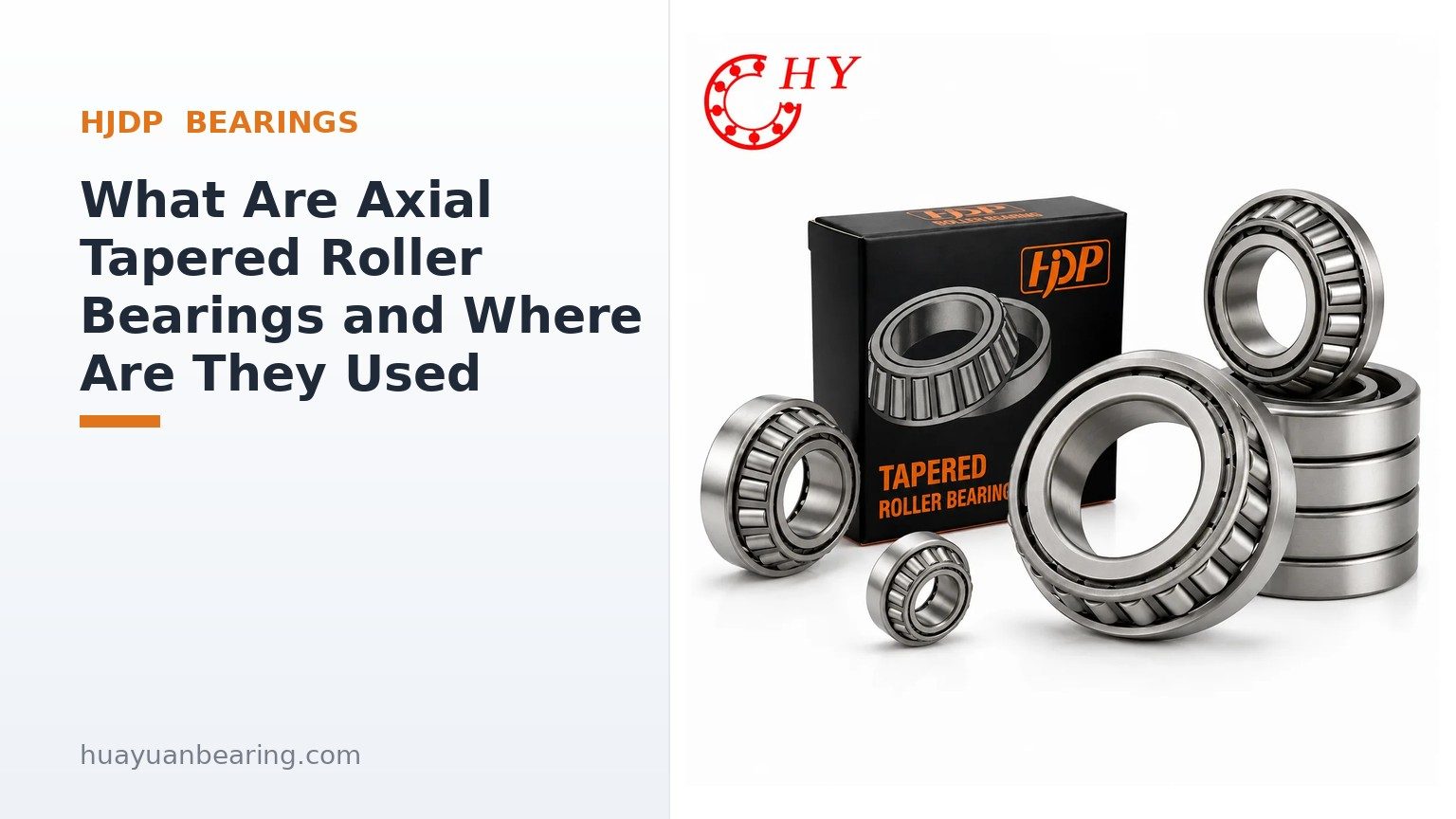
Axial tapered roller bearings carry load mainly along the shaft axis, that is, as thrust, rather than purely radially. In the trade the term covers two things: true thrust tapered roller bearings, built as opposed cup-and-cone pairs for one-direction axial load, and radial tapered roller bearings, whose angled rollers also absorb a large axial component. Both depend on hardened bearing steel, a defined contact angle, correct axial clearance and correct pairing. Clearance setting and mounting practice decide service life far more than any catalogue number. This guide is published by huayuanbearing.com, the site of Jinan Huayuan Bearing Co., Ltd.
What Are Axial Tapered Roller Bearings Made Of?
An axial tapered roller bearing is a separable assembly of four hardened steel parts: the cone (inner ring), the cup (outer ring), tapered rollers and a cage. The roller axes converge on one point on the shaft axis, so every contact surface is part of a single cone and the rollers roll instead of scrubbing.
Because the assembly is separable, cone and cup can be mounted and inspected independently. That matters in repair work: cup seats in the housing can be checked separately from cone seats on the shaft, and those seats are where most fitting errors begin.
How does the contact angle decide axial capacity?
The contact angle is the angle between the raceway and a line perpendicular to the bearing axis; the steeper the angle, the larger the share of load carried axially. Ordinary radial tapered bearings use a narrow angle, while thrust and steep-angle designs use a much larger one so the full roller length works against axial load. The angle is fixed by the raceway, cannot be changed by adjustment, and must be read from the drawing rather than guessed from a part number.
Why does the cage matter more in a thrust design?
In a thrust bearing the cage has to hold the rollers when the bearing is unloaded or turning slowly, because no radial force presses them onto a raceway. A pin-type or window-type cage that retains every roller is therefore a functional requirement, not a cosmetic detail. Radial bearings commonly use a stamped steel cage; heavily loaded or high-speed sets may specify a machined brass or polymer cage, and the drawing states which.
How Do Axial and Radial Tapered Roller Bearings Differ?
They differ in load direction, mounting arrangement and adjustability, not in steel quality. A single tapered bearing takes axial load in one direction only, so axial location always needs an opposing bearing or a thrust pair.
Tapered geometry is efficient because line contact between roller and raceway spreads load over a large area. The penalty is that the bearing must be adjusted: too much clearance lets rollers skew, too little preload overheats grease and steel.
| Characteristic | Axial (thrust) tapered roller | Radial tapered roller, paired | Cylindrical roller |
|---|---|---|---|
| Main load direction | Axial, one direction per bearing | Radial plus axial from the contact angle | Radial only |
| Axial capacity | High, in one direction | Moderate to high, one direction per row | None without a separate location bearing |
| Radial capacity | Low to none | High | High |
| Mounting | Two bearings facing each other, or a thrust pair | Two rows opposed, then adjusted | One end located, other end free for thermal growth |
| Setting | Axial clearance by shim or nut | Axial clearance or preload at assembly | Radial internal clearance built in |
| Typical positions | Vertical shafts, screw-down and mill stands, thrust positions in gearboxes and winches | Wheel hub pairs, differential pinions, gearbox shafts, trailer axle ends | Gearbox and motor shafts, idler positions |
| Speed | Low to moderate, oil preferred | Moderate, grease acceptable | High |
When should a thrust pair replace a radial pair?
A thrust pair is the better choice when axial load dominates and radial load is light, for example on a vertical shaft or a heavily axial gearbox shaft. Fitting a radial tapered bearing to a purely axial load wastes its radial capacity and puts the stress on the rib, the weakest part of the assembly. The trade-off is speed and lubrication: thrust tapered bearings generally run slower and prefer oil. Where load is radial-dominant with only moderate axial components, a cylindrical roller bearing with a separate location bearing is often the simpler arrangement; the difference is set out in this comparison of tapered vs cylindrical roller bearings.
Where do radial tapered roller bearings carry axial load on a vehicle?
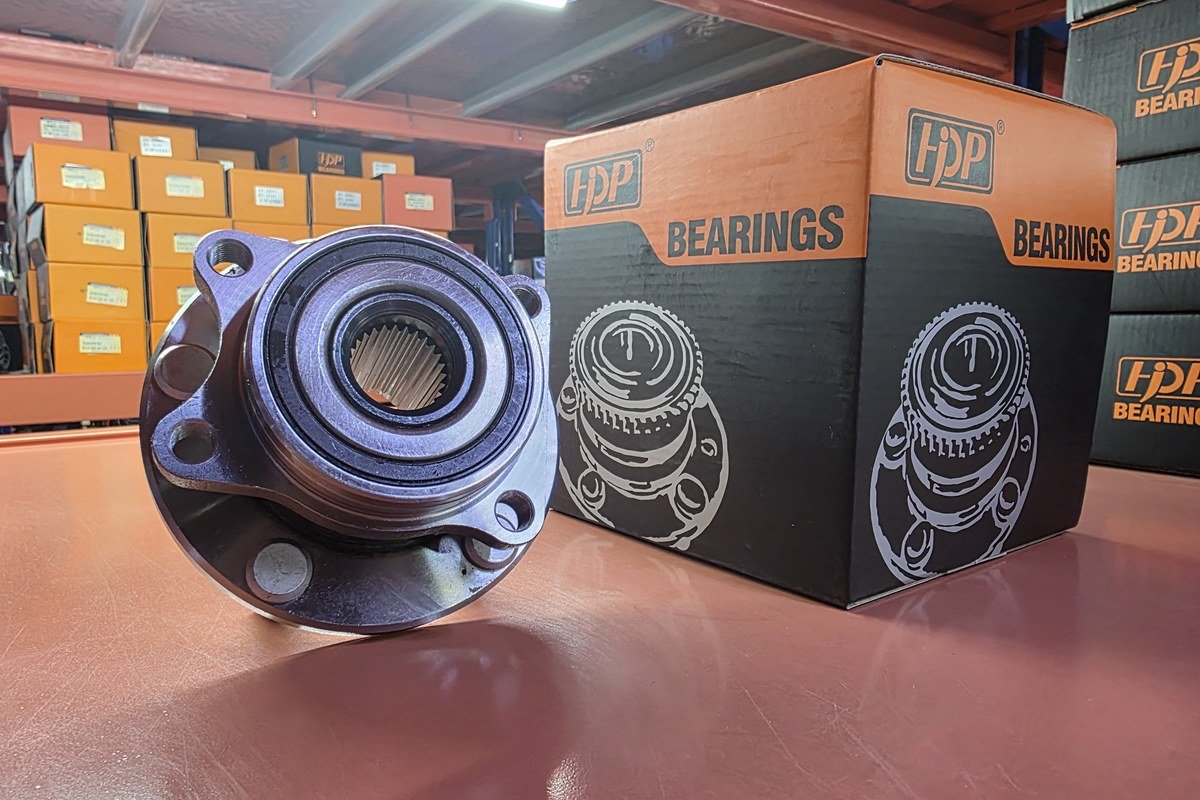
They appear wherever a shaft must be located axially while carrying radial load: wheel hub pairs, differential pinions, gearbox shafts, trailer axle ends and steering gears. In a hub, two rows are mounted face-to-face or back-to-back and adjusted to a small preload or clearance, which controls wheel end play and brake disc runout.
The travel-system range from Jinan Huayuan Bearing Co., Ltd. covers hub bearings, hub units, tensioners and CV joints, and tapered roller bearings are one part of that range rather than the whole answer. CV joints use needle rollers or balls because they must articulate, and tensioner pulleys typically use sealed ball bearings because load is light and speed high; the needle roller side is explained in this note on universal joint needle roller quality. The full tapered range is listed under tapered roller bearings on huayuanbearing.com.
Which Wheel Hub Bearing Generation Fits the Application?
Generation 1, 2 and 3 describe how much of the hub is built into the bearing, not how good the bearing is. A generation 1 bearing can be as durable as a generation 3 unit, but it takes longer to fit and depends far more on the installer.
| Generation | What is integrated | How it mounts | Service note |
|---|---|---|---|
| Generation 1 | Double-row angular contact bearing with seals, separate hub | Pressed into the knuckle or hub carrier | Needs correct seating and a press; bearing and hub separated at replacement |
| Generation 2 | Bearing with a flange on the outer ring, hub flange still separate | Bolted to the suspension or brake carrier | No housing press fit, but the hub flange is still pressed into the inner ring |
| Generation 3 | Complete hub unit: wheel flange on the inner ring, mounting flange on the outer ring, sealed and pre-set, encoder commonly integrated | Bolted to the knuckle as one unit | Replaced as a complete assembly; installation repeatability is highest |
What changes from generation 1 to generation 3?
Each step moves work from the workshop to the supplier. Generation 1 requires pressing and careful seating; generation 2 removes the housing fit but keeps a pressed hub flange; generation 3 arrives greased, sealed and pre-set with the wheel flange integrated. The trade is unit cost against fitting time and repeatability, because a generation 3 unit removes the most common installation error, a cocked or under-seated bearing.
How do you confirm generation and fitment?
Confirm against the drawing and a physical sample, not against an OE number alone. Check the flange bolt pattern and pilot diameter, the position and type of the ABS sensor, the brake disc mounting face and the overall installed height. OE references are frequently superseded, and two visually similar units can differ in sensor type or flange offset, so any part number and OE reference is confirmed against the drawing and sample.
How Do You Read a Tapered Roller Bearing Drawing?
Read a tapered roller bearing drawing in a fixed order: envelope, pairing, geometry, ratings, clearance, tolerance class, then interface details. Most ordering errors come from reading a dimension without reading the tolerance attached to it.
- Envelope dimensions. Bore d, outside diameter D, total width T, cone width B and cup width C, each with its own tolerance.
- Pairing and stand-out. Whether cone and cup are a matched set, whether they carry a pair number, and the stand-out value that sets preload when the pair is clamped.
- Contact angle and roller profile. Nominal angle, roller count, and whether the profile is crowned or logarithmic.
- Load ratings. Dynamic rating, static rating and fatigue load limit, with the reference and limiting speeds the ratings hold at.
- Clearance or preload. Axial clearance range at a stated measuring load, or the rolling torque range for a preloaded set.
- Tolerance class. Normal, P6, P5 or a customer class, applied to bore, outside diameter and runout.
- Cage and internal design. Cage material and type, roller complement, and rib details that affect lubricant flow.
- Interface features. Fillet radii, abutment diameters, snap ring grooves, seal grooves and sensor ring position.
- Marking and traceability. What must appear on cup and cone, and how the batch is identified.
Which drawing features cause the most fitting problems?
Abutment fillet radius and shoulder diameter are a common cause of fitting problems, because a radius that is too large stops the cone short of its seat. Total width T and stand-out come next: on a matched pair they decide preload, and a pair assembled from two different sets will not hold the specified clearance.
Which Material, Heat Treatment, Clearance and Lubrication Should You Specify?
Specify steel grade and hardness, tolerance class, axial clearance and lubrication as four separate lines, because the same part number can be built to different specifications.
What steel and heat treatment are used?
Through-hardened chromium bearing steel such as GCr15 or 100Cr6 is the usual choice for tapered rings and rollers, hardened and tempered to a hardness in the low sixties HRC, with a stabilising temper for dimensional stability. Where shock loads or thin sections are involved, case-carburised steel such as 20CrMnTi gives a hard surface with a tough core. Hardness, case depth and retained austenite limits belong on the drawing, because they are values an incoming inspection can actually check.
Which precision grade and clearance apply?
Precision class and clearance are separate decisions. The class controls bore, outside diameter and runout; the clearance controls how the bearing behaves after it is clamped. Tapered bearings are normally set by axial clearance rather than radial internal clearance, measured with a dial indicator under a defined axial load, or by rolling torque on a preloaded set. Re-check the value after the first heat cycle, because shaft and housing expansion move it.
How are sealing and lubrication specified?
Sealing and grease are specified together, since a grease that suits a double-lip seal may not suit an open gearbox bearing running in oil. Hub units are greased for life and sealed on both sides, often with an integrated encoder. Open bearings rely on the housing seal, so the drawing should state grease quantity, base oil viscosity and operating temperature range. In dusty or wet positions, a labyrinth or V-ring in front of the seal extends life more than a thicker grease does.
How Do These Bearings Fail, and What Do the Symptoms Show?
Most tapered roller bearing failures in service begin with fitting, lubrication or clearance, and only later become material fatigue. Reading the symptom before dismantling narrows the cause quickly.
| Symptom | Likely cause | What to check |
|---|---|---|
| Growl that rises with speed, changes note in a turn | Raceway spalling or wear, often from contaminated grease | Rotate by hand, inspect the raceway, examine grease under the seal |
| Blueing, heat discolouration, grease weeping from a new build | Insufficient axial clearance, over-preload | Axial clearance and rolling torque against the drawing value |
| Roller end wear, cage pocket wear or cage fracture | Excess clearance, roller slip under light load | Preload setting, load rating against actual duty |
| Visible play at the wheel, uneven tyre wear | Worn bearing or incorrect seating | Nut torque, cone and cup seating, hub end play |
| Evenly spaced marks on the raceway | False brinelling from vibration in transit or long storage | Shipping and storage practice, mounting method |
| Rust or emulsified grease | Damaged seal lip, water ingress | Seal condition, housing venting, wash-down routine |
A bearing that growls in proportion to road speed and changes note in a turn is usually a wheel end bearing with a damaged raceway; the diagnostic sequence is set out in this guide to what causes wheel bearings to go bad. Grease weeping from a freshly assembled set points to preload rather than to the bearing itself.
How Should You Install, Replace and Inspect a Delivery?
Correct installation is a sequence, not a single action: verify, clean, seat, lubricate, adjust, then confirm by measurement.
- Verify the part number, pair number and drawing revision before unpacking the second unit.
- Clean the shaft and housing, remove burrs and nicks, and measure the seat diameters against the drawing.
- Check that the cone seats square against its shoulder, with no paint, sealant or burr on the seat face.
- Fit by controlled heat or a press sleeve applied to the inner ring only; never transmit press force through the rollers.
- Seat fully and feel for a solid stop, then confirm contact at the shoulder with a feeler gauge.
- Lubricate the bearing and wet the seal lips with the specified grease before assembly.
- Set axial clearance or preload with the specified shim, spacer or nut, measure with a dial indicator at the stated axial load, and confirm rolling torque.
- Run in, watch the temperature rise, and re-check clearance after the first heat cycle.
What should incoming inspection cover?
Incoming inspection should confirm identity, dimensions and condition before parts reach the workshop.
- Carton and label data against the drawing: part number, pair number, batch, quantity.
- Bore, outside diameter and total width measured with a micrometer, not sampled by eye.
- Axial clearance checked on a fixture at the stated load, or rolling torque on a preloaded set.
- Rotation feel and sound: smooth, no catch, no grit, no axial rock beyond specification.
- Seal lip condition, cage rivets, roller count and rust preventive film.
- Retain one sample per batch for comparison against the next delivery.
For custom packaging and private label runs, label position, artwork revision and carton marking must match the approved proof; the wider process is described in this article on private label automotive bearings. Product pages are also published in Indonesian and Vietnamese for buyers in those markets, for example the Indonesian tapered roller bearing page.
Frequently Asked Questions About Axial Tapered Roller Bearings
Are axial tapered roller bearings the same as thrust tapered roller bearings?
In most catalogues, yes. Axial describes the load direction, and a thrust tapered roller bearing is the axial version of the design: a single-direction bearing that needs an opposing bearing to locate the shaft. Some suppliers also use axial loosely for steep-angle radial types, so confirm the geometry on the drawing before ordering.
Can one tapered roller bearing carry axial load in both directions?
No. A single-row tapered bearing takes axial load in one direction only, because the rollers can be loaded against the cup in one sense. Axial location therefore needs a second bearing facing the opposite way, or a double-row arrangement such as a matched pair or an integrated hub unit, which handles both directions within one envelope.
How is axial clearance set on a matched pair?
By shim, spacer or nut, then verified by measurement. Fit the pair, apply the axial load stated on the drawing, and read movement with a dial indicator; on a preloaded set, measure rolling torque instead. Adjust the shim or spacer, reassemble, and re-check after the first run-in heat cycle.
What information is needed for a custom bearing or private label order?
A drawing or a physical sample, the dimensions and tolerances, clearance or preload, seal and grease specification, and the expected quantity pattern. For private label, add artwork, label position and carton marking. Hua Yuan develops parts from drawings and samples and supports custom packaging and own-brand marking; part numbers and OE references are confirmed against the drawing and sample.
Purchasing guidance, product information and company updates from Huayuan Bearing.