
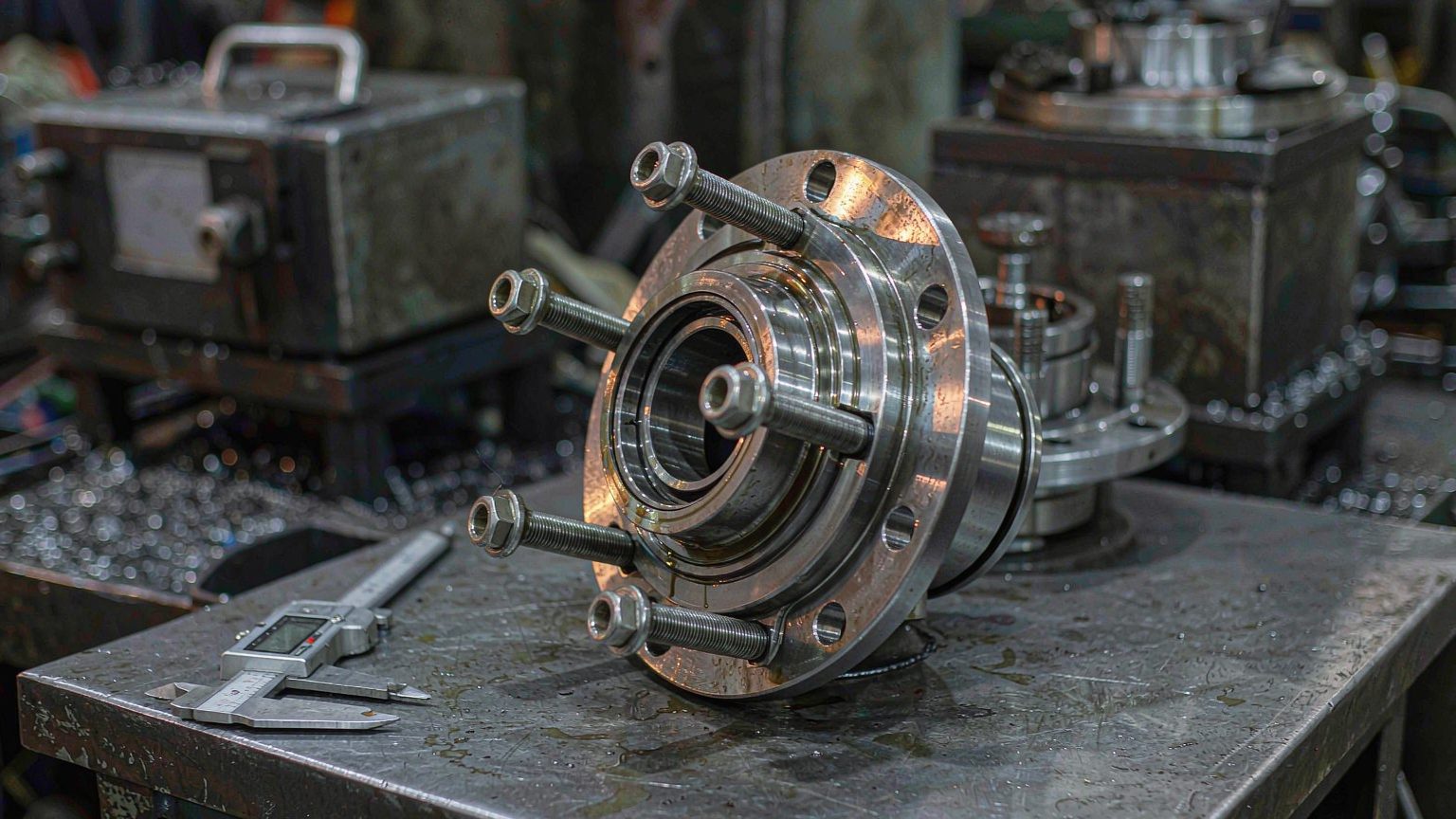
01299 518507 is a reference pair that bearing catalogues and OE lookup systems use to identify one wheel hub bearing unit, and on its own it says nothing about dimensions, sealing, clearance or load rating. A reliable match comes from the drawing: bore, flange diameter and offset, bolt pattern, ABS encoder type, seal design and pre-set axial play, confirmed by measurement and against a physical sample. Jinan Huayuan Bearing Co., Ltd., the wheel-end and driveline parts manufacturer behind huayuanbearing.com, treats numbers like this as drawing enquiries rather than catalogue lookups.
What Is 01299 518507 and What Does the Number Actually Identify?
01299 518507 identifies a wheel hub bearing unit family, not a specific vehicle, and the two blocks in the string normally belong together: the short block points to a series or catalogue group, the long block to the individual item.
Reference strings of this shape appear in three places at once: bearing makers' catalogues, OE parts systems, and the interchange tables that distributors build for themselves. Each of those systems was created at a different time and revised independently, so one physical hub unit can carry several numbers, and one number can be superseded by another when the unit is re-engineered with a different seal, a changed encoder or a reinforced flange.
Why the same hub unit appears under several numbers
A number is assigned by whoever catalogued the part, not by the part itself. When an OE manufacturer revises a hub unit mid-cycle, the new version often keeps the old reference in interchange tables alongside a new one, and aftermarket catalogues then list both. That is convenient for a parts counter and dangerous for a buyer, because an interchange list is a claim of similarity, not evidence of dimensional identity.
What the number does not tell you
- Bore diameter, flange diameter, flange offset and bolt circle
- Whether the unit carries a magnetic encoder or a toothed ring, and the pole count
- Seal architecture: single lip, double lip, cassette or labyrinth
- Grease type, fill quantity and the temperature range it was chosen for
- Pre-set axial play or starting torque, and the method used to measure it
- Flange material, heat treatment and corrosion protection
This is why a supplier who answers "yes, we have 01299 518507" without asking for a drawing is guessing. The honest answer is a drawing plus a question list, and that is the answer a buyer should expect from any manufacturer of wheel hub bearings.
How Is a Wheel Hub Bearing Unit Built, and Which Generation Fits Your Application?
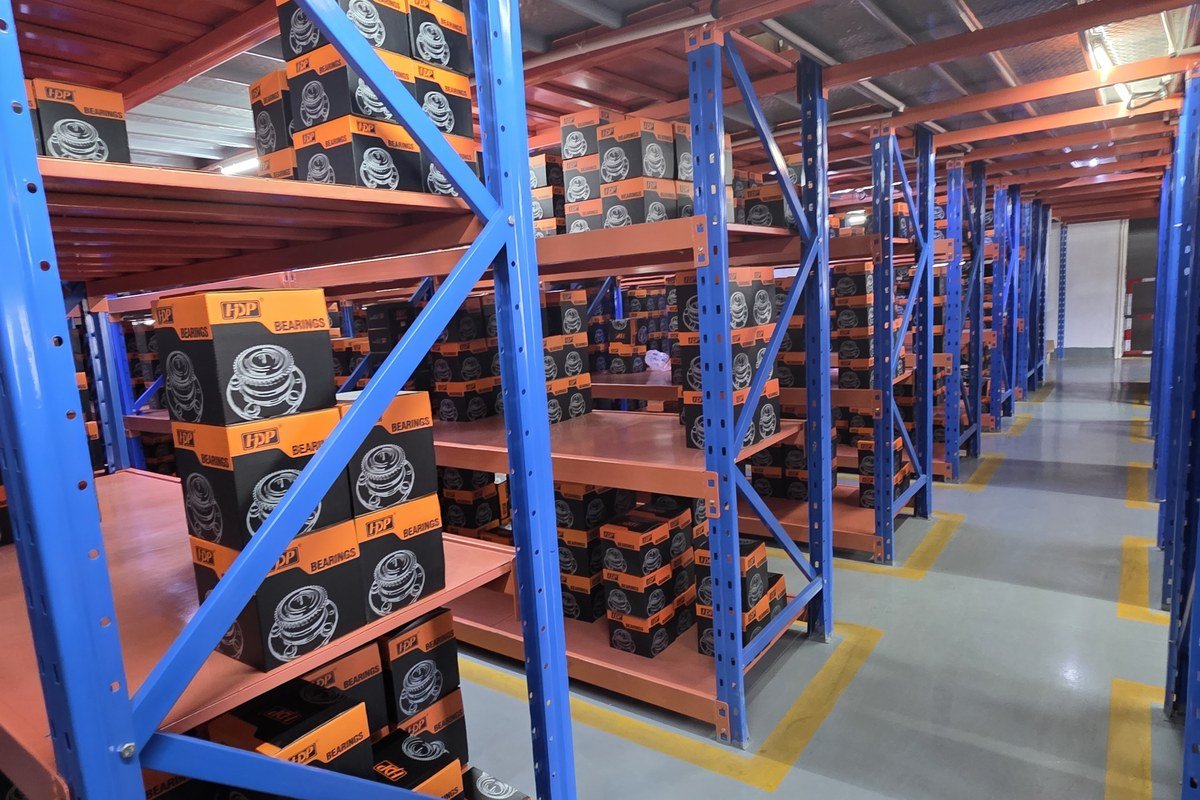
A wheel hub bearing unit is a sealed, pre-greased, pre-set assembly that combines a double-row rolling bearing with a mounting flange, integral seals and, on modern units, a magnetic encoder ring for the ABS sensor — which is why the reference number identifies an assembly rather than a bare bearing.
Because the unit is replaced whole, it also carries the settings that used to be made during installation. Preload, sealing and grease quantity are fixed at the factory, and the fitter's only job is to clamp it correctly and keep it clean.
What is inside a sealed hub unit
Inside the housing there are normally two rows of balls or rollers running on hardened raceways, a cage separating them, an inner-ring pair ground as a matched set, a measured grease fill, and one or two seal packs. Gen 3 units add a wheel flange with studs on the inner ring and an encoder on the seal or on a stamped carrier ring.
First, second and third generation units compared
The generation names describe how the bearing is integrated with the surrounding suspension hardware, not how good the part is; a well-sealed Gen 1 unit on a light trailer can outlast a poorly sealed Gen 3 unit on a heavy SUV.
| Generation | What the unit includes | How it mounts | Rolling element commonly used | What to confirm on the drawing |
|---|---|---|---|---|
| Gen 1 | Sealed double-row bearing, no flange | Pressed into the knuckle or onto the spindle; the hub is reused | Double-row angular contact ball or tapered roller | Bore, width, seal type, pre-set play |
| Gen 2 | Bearing with a flange on the outer ring | Bolted to the knuckle or strut; hub and brake disc remain separate | Double-row angular contact ball | Flange bolt circle, offset, spigot diameter, encoder position |
| Gen 3 | Complete assembly with wheel flange, studs and encoder | Bolted to the knuckle; wheel and brake disc mount to the flange | Double-row angular contact ball, tapered roller on heavier vehicles | Flange offset, stud pattern, encoder type, axial play |
When a buyer sends 01299 518507, the first engineering question is which of these three architectures the drawing shows, because flange geometry, encoder position and clamping method differ between them and none of it is visible in the number.
Ball, tapered roller or cylindrical roller inside the unit
Double-row angular contact ball bearings dominate passenger-car hub units because they run with low drag, need little axial space and give predictable stiffness. Double-row tapered roller bearings appear where the unit must carry heavier combined loads — large SUVs, light commercial vehicles, trailer axles — and they only work when the preload is set correctly. Cylindrical roller bearings favour radial capacity over axial location and are more often found in gearbox and industrial positions than at the wheel.
Which Material, Heat Treatment, Clearance and Sealing Choices Decide Service Life?
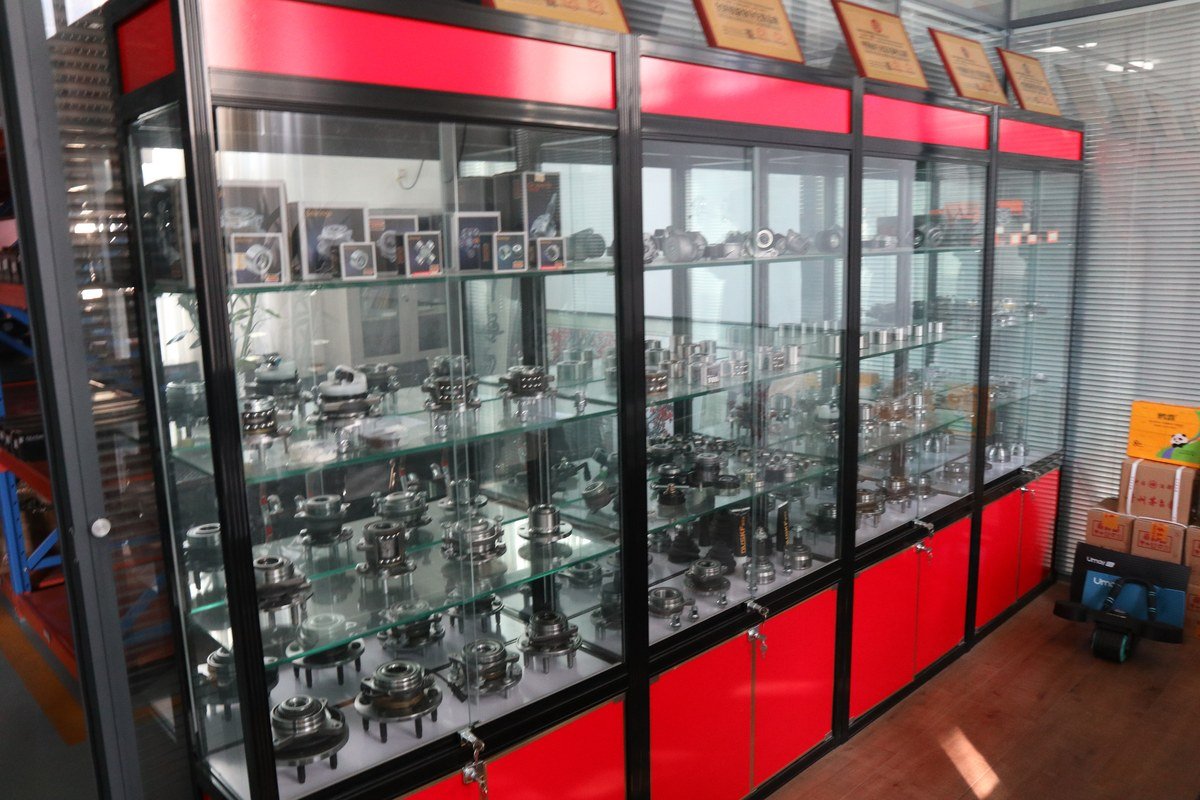
Two hub units can share a drawing envelope and still differ by a factor of two in life, and the difference usually sits in heat-treatment control, seal design and the stability of the pre-set clearance rather than in the nominal steel grade.
Bearing steel, cages and heat treatment
Rings and rolling elements in automotive hub units are commonly made from through-hardening bearing steel — GCr15 in Chinese standards, 100Cr6 in European standards — hardened and tempered to roughly 60–64 HRC, with carbide distribution and retained austenite controlled so the part stays dimensionally stable at operating temperature. Flanges are typically a medium-carbon steel such as S55C, induction hardened at the raceway and around the bolt holes. Cages are glass-fibre reinforced polyamide for most passenger applications and steel where temperatures or loads run higher.
Clearance, preload and precision grade
A hub unit does not use a clearance class that you adjust on the vehicle. The inner-ring pair is ground so that axial play or starting torque lands inside a window set by the drawing, and that window — with its measuring method, gauge and applied load — is what belongs on the purchase specification. Precision classes such as ISO 492 normal, P6 or P5 describe runout and dimensional accuracy; runout matters here because it shows up as brake judder and an uneven ABS signal, not only as noise.
Seal design and grease fill
The seal decides life in wet or dusty markets. One lip keeps grease in; a cassette or labyrinth pack keeps water out. Nitrile (NBR) covers most temperate use, hydrogenated nitrile (HNBR) or fluoroelastomer (FKM) suits the higher temperatures near the brake. Grease is normally a lithium-complex or polyurea type filled to a fraction of the free space, and the two thickener families are not interchangeable — mixing them softens the grease and shortens bearing life.
| Drawing parameter | What it controls on the vehicle | What to confirm before quoting |
|---|---|---|
| Bore diameter | Fit on the spindle or hub pilot | Nominal size and tolerance band |
| Flange diameter and spigot | Location in the knuckle, centring of the brake disc | Diameter, chamfer, permitted runout |
| Flange offset | Wheel track and brake disc position | Distance from mounting face to bearing centreline |
| Bolt circle, hole count, thread | Whether the unit bolts to your knuckle or hub | Pitch circle diameter, hole count, thread size, hole type |
| ABS encoder | Signal for the speed sensor, ABS and stability control | Magnetic encoder or toothed ring, pole count, sensor position |
| Seal design | Water and dust exclusion over the service interval | Lip material, number of lips, labyrinth or cassette type |
| Axial play or starting torque | Bearing preload, noise and heat | Value, measuring method, gauge and applied load |
| Marking and packaging | Traceability and brand presentation | Laser marking, box print, barcode content |
What Loads Do Hub Units, Tensioners and CV Joints Carry?
Hub units, tensioner pulleys and CV joints all sit in the driveline, and each carries a different load signature; matching the specification to that signature is more useful than comparing catalogue load ratings alone.
Hub units: radial load plus a cornering moment
A front hub unit carries the vertical wheel load as radial load, the cornering force as axial load, and — because the tyre contact patch sits outboard of the bearing centreline — a bending moment that grows with wheel offset and with tyre grip. That moment, not the pure radial load, is what usually limits life on wide-track vehicles and on vehicles run heavily loaded.
Tensioners: spring load, vibration and heat
A belt tensioner is a spring-loaded arm carrying an idler pulley on a sealed bearing. The bearing sees a steady radial load from belt tension, superimposed vibration from the engine, and heat radiated from the block. The usual failure is not a dramatic seizure but gradual grease loss and seal stiffening, followed by pulley rumble and then belt slip. The tensioner's damper and spring decide whether the belt stays stable at idle, which is why changing only the pulley sometimes leaves the noise unchanged.
CV joints: torque at steering angle
A fixed ball-type CV joint transmits torque through six balls running in curved races in an inner and an outer race, held by a cage; the curved races let the joint articulate while the balls stay in the bisecting plane, so speed remains constant through the angle. A plunge joint, usually a tripod design, allows shaft length to change as the suspension moves. In both designs the boot and its grease are the life-limiting items: once the boot splits, abrasive paste forms and the joint fails quickly.
What Are the Common Failure Modes, and What Do They Sound Like?

Most hub unit failures fall into a small number of patterns, and each pattern leaves a different signature on the removed part, so the returned unit can usually confirm the diagnosis.
| Failure mode | Usual cause | What the technician notices | What to check on the part |
|---|---|---|---|
| Fatigue spalling | End of designed life or sustained overload | Hum that rises with road speed and shifts when load transfers in a bend | Raceway flaking, play at the flange |
| False brinelling | Long standstill or vibration during transport | Rumble in a narrow speed band | Evenly spaced depressions at ball pitch |
| Water ingress | Split, hardened or wrongly fitted seal | Rust-coloured grease weeping, then rumble | Seal lip condition, corrosion tracks on the raceway |
| Loss of clamp load | Reused axle nut or wrong torque | Click or knock on load reversal, warning lamp | Nut condition, contact faces, flange fretting |
| Encoder damage | Handling, metal debris, hammer use during removal | ABS or stability-control warning with normal bearing noise | Encoder ring, sensor gap, debris on the ring |
| Installation damage | Force applied through the inner ring or cage | Noise within the first few hundred kilometres | Brinelling marks, cage deformation, mounting marks |
How to separate hub bearing noise from tyre and brake noise
Change one variable at a time. A wheel bearing tone follows road speed, changes when load transfers in a bend, and stays roughly constant under gentle braking. Tyre noise follows surface texture; brake noise appears or disappears with pedal pressure; a worn CV joint usually clicks on full lock under power. If the tone changes when the vehicle is steered left and right at constant speed, the loaded side in each direction is the side to inspect.
How Do You Read the Drawing and Verify 01299 518507 Before Ordering?
Verifying a reference like 01299 518507 is a dimensional exercise rather than a catalogue exercise, and it takes far less time than correcting a wrong shipment.
- Send every number you have, plus the application. The reference pair, any OE-style number, the vehicle or machine, and the position on the vehicle. The number alone rarely settles the question.
- Ask for a dimensioned drawing rather than a photograph. A drawing shows bore, flange offset, bolt circle and encoder; a photo shows a shape that several different units share.
- Measure the part you removed. Bore, flange diameter, offset from the mounting face to the bearing centreline, bolt circle and hole count, and the encoder type. Record the values with the measuring tool used.
- Confirm the sensor interface. Magnetic encoder or toothed ring, pole count, and the sensor gap the vehicle expects — a warning lamp after fitting is often an encoder mismatch rather than a bearing fault.
- Agree seal, grease and marking before the first batch. These are the items that separate a low-cost unit from a durable one, and the items buyers most often forget to specify.
- Approve a sample against the drawing and keep the record. The approved drawing becomes the reference for every repeat order, which is what keeps batch three identical to batch one.
What a usable drawing must show
A drawing you can actually order from carries the bore and its tolerance, the flange diameter and spigot, the offset from mounting face to bearing centreline, the bolt circle with hole count and thread, the encoder type and pole count, the seal cross-section, the axial play window with its measuring method, and the marking text. If any of those is missing, the quotation is built on an assumption.
What to check when the cartons arrive
Compare carton marking and part marking with the approved drawing first, then measure a sample for bore, flange diameter, offset and bolt circle. Inspect the seal lip for cuts or deformation, confirm the encoder type with a sensor or a small magnet, and turn each sampled unit by hand to feel for roughness or play. Record batch numbers so that any later problem can be traced to a production run instead of the whole stock.
Jinan Huayuan Bearing Co., Ltd. develops wheel hub bearings, hub units, tensioners and CV joints from drawings and samples, supports custom packaging and buyers' own brand marking, and serves aftermarket and OE-supply customers mainly in the Middle East and Southeast Asia. Those product families are grouped on the wheel hub bearing and driveline range page.
How Should a Hub Unit Be Installed and Replaced?
Fitting practice decides whether a correctly specified hub unit reaches its design life, and most premature returns trace back to clamping and handling rather than to the bearing itself.
- Clean the knuckle bore and the spindle face; a metal chip or a film of paint under the flange tilts the unit and shows up as runout.
- Never strike the unit, and never press through the inner ring or the cage — fitting force goes through the flange or the outer ring only.
- Fit a new axle nut where the design uses a staked or torque-to-yield nut, and tighten to the figure the vehicle maker specifies.
- Check rotation and axial play before the wheel goes back on; a stiff or notchy unit has usually been misaligned during fitting.
- Keep the encoder clean and free of metal debris, and avoid impact near the sensor ring.
- Replace both sides of an axle when wear is comparable, then road test in both directions to confirm the tone has gone.
Where a number such as 01299 518507 is disputed between catalogues, the drawing decides and the number does not. Huayuan Bearing works from that principle on every enquiry raised through the Huayuan Bearing site.
Frequently Asked Questions About 01299 518507 and Wheel Hub Units
Is 01299 518507 the same as an OE number?
Not necessarily. It behaves like a catalogue reference pair, while OE systems use their own numbering, so one unit can appear under several numbers in different catalogues. Treat any list of equivalents as a lead to check rather than proof, and confirm the match against drawing dimensions and, where possible, the part you removed. When two numbers disagree, the drawing settles it.
Can Huayuan Bearing supply a hub unit to my own drawing?
Jinan Huayuan Bearing Co., Ltd. develops hub units, wheel hub bearings, tensioners and CV joints from drawings and samples, so the starting point is your drawing or a sample together with the operating conditions. Custom packaging and buyers' own brand marking are supported. Seal type, grease, encoder and marking should be agreed in writing before production, with confirmation against the approved drawing and sample.
How do I inspect a hub unit when it arrives?
Check carton marking and part marking against the approved drawing, then measure a sample for bore, flange diameter, offset and bolt circle. Look at the seal lip for cuts or deformation, confirm the encoder type with a sensor or a magnet, and turn the unit by hand to feel for roughness or play. Keep batch numbers so a problem can be traced to one production run.
Which seal and grease should I specify for hot, dusty markets?
For high ambient temperature and dust, specify a cassette or labyrinth seal with an HNBR or FKM lip rather than a single nitrile lip, and a grease whose thickener and base oil suit the temperature at the wheel. Ask for the seal drawing and the grease data sheet with the quotation, and keep one grease type per programme — mixed thickener types soften in service and shorten life.
Purchasing guidance, product information and company updates from Huayuan Bearing.